 Solitaire-Online
Play Now
Solitaire-Online
Play Now
Solitaire-Online
Play Now
Solitaire-Online
Play Now
Everything from your very first deal to the strategy that turns a losing hand around, written for people who actually want to get better.
Set up the seven-column tableau, learn every legal move and play a complete game of classic solitaire.
9 min read RulesTwo decks, ten columns and eight runs to build. Learn why the suit count changes everything.
7 min read RulesEvery card face up, four free cells, and almost no luck. Learn the maths behind moving several cards at once.
7 min read RulesNo stock, no mercy, and only one landing spot per card. The rules, and the plan that actually beats them.
9 min read RulesTwo decks, one pass through the stock and no group moves. The rules, and why empty columns are the whole game.
9 min read RulesKlondike without the stock, and with a move so generous it changes how you read the board.
7 min read RulesPairs that add to thirteen, two redeals, and one buried card that can end the whole game.
7 min read RulesOne rank up or down, Ace wraps to King, and the streak bonus that rewards planning a chain before you start it.
6 min read RulesOne rank up or down, no wrapping, and a King that stops a chain dead.
6 min read RulesA casino game built to beat you: a thirteen-card reserve, a random base rank and foundations that wrap.
7 min readCartomancy, a Victorian rulebook, a gold rush, and the intern whose card game shipped on every PC on earth.
6 min read ReferenceResearch-backed Klondike and FreeCell results, with the rules and limits behind the numbers.
5 min read ReferenceTableau, talon, reserve, supermove: every term you will meet, defined in plain English.
5 min read ReferenceCompare nine solitaire games by layout, rules and the kind of decisions you enjoy.
7 min readFind the rules, a real screenshot and practical advice on each game page. Multiplayer games are listed separately.
 Solitaire
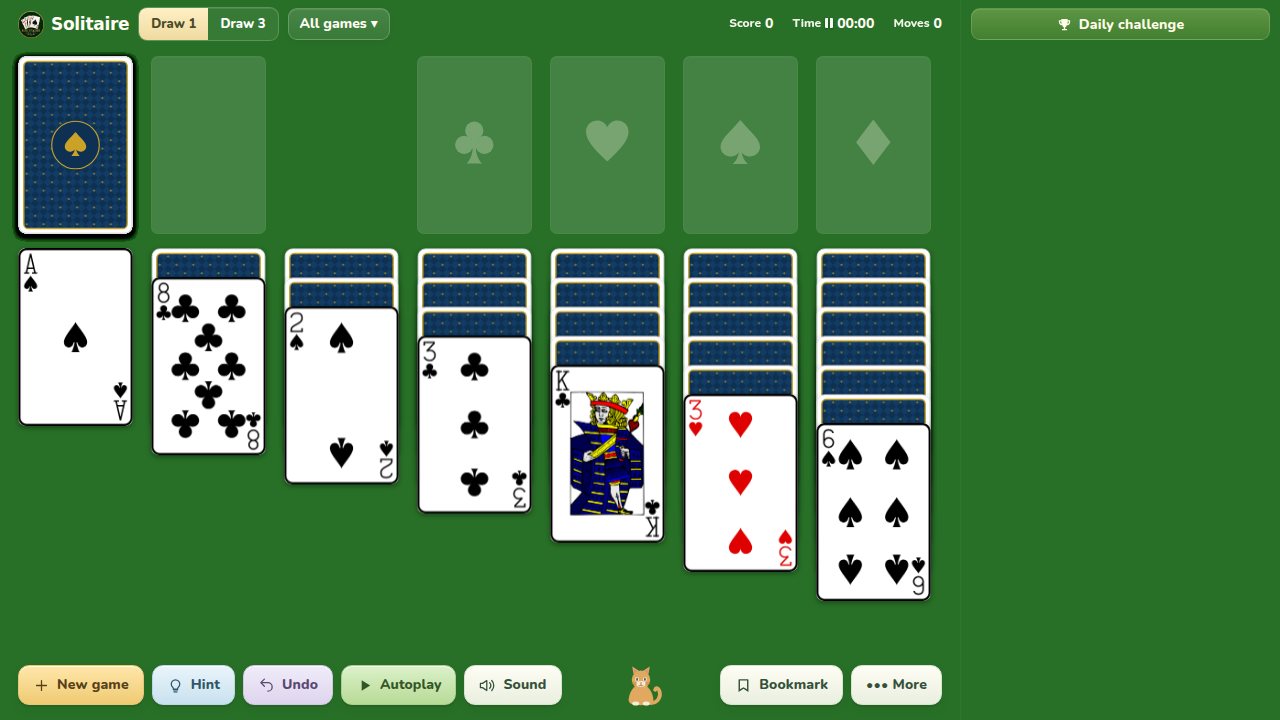
Klondike is the classic solitaire game, the seven-column original that shipped with every home computer for three decades and that most of the world simply calls "solitaire." This version is free, runs in your browser with nothing to install, and plays exactly the way you remember it: drag cards or tap them, undo as much as you like, and switch between the relaxed Draw 1 mode and the classic Draw 3 challenge at any time.
Rules · Screenshot · Strategy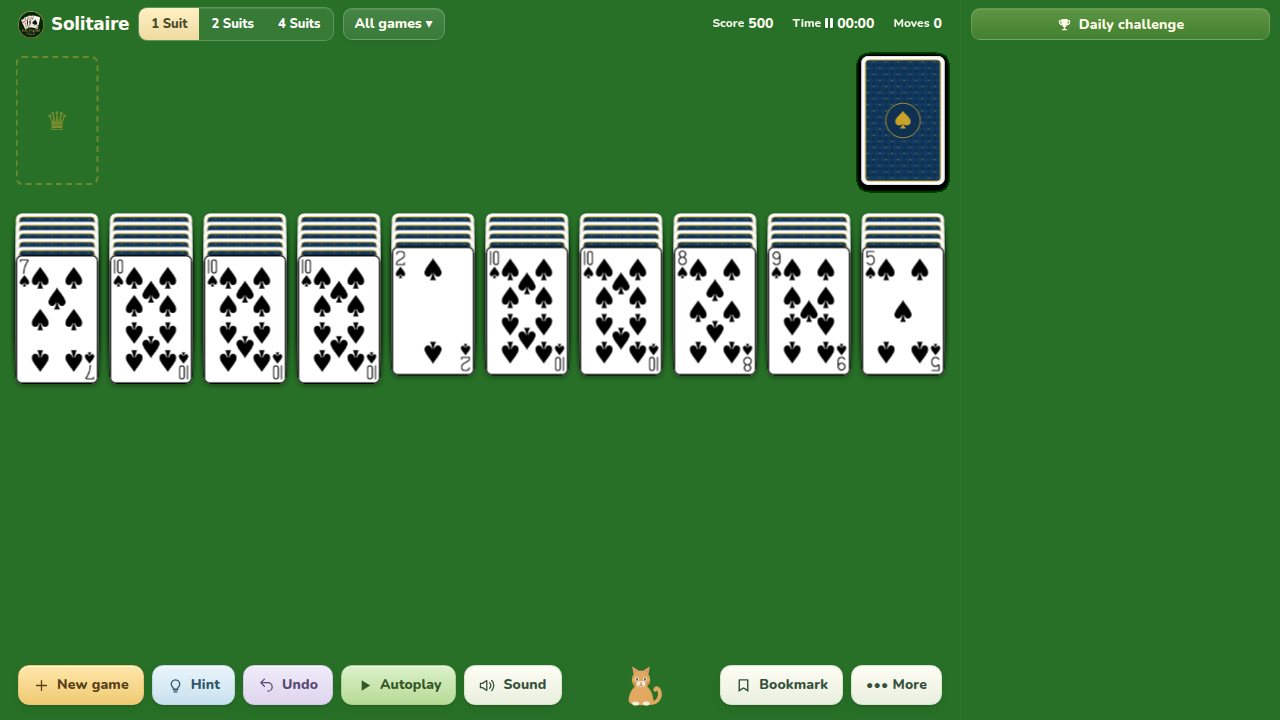 Solitaire
Spider solitaire deals 104 cards from two full decks across ten columns, and asks you to untangle them into eight complete King-to-Ace runs. There are no foundations to build and no waste pile to cycle: everything happens on the board, which is why Spider is often called the thinking player's solitaire.
Rules · Screenshot · Strategy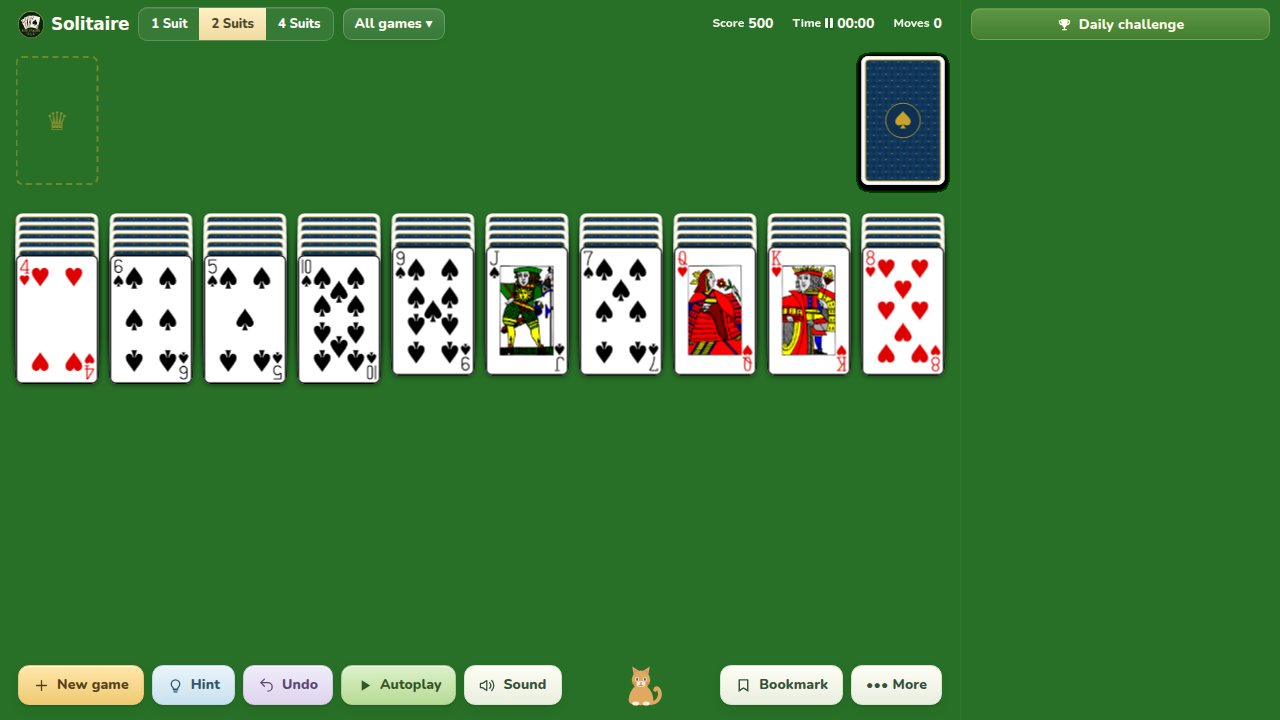 Solitaire
Spider Solitaire 2 Suits is the balanced version of the two-deck classic. It uses spades and hearts across ten tableau columns, giving you more decisions than one-suit Spider without the full four-suit tangle. This page starts directly in two-suit mode, so you can deal immediately with no download, account or sign-up.
Rules · Screenshot · Strategy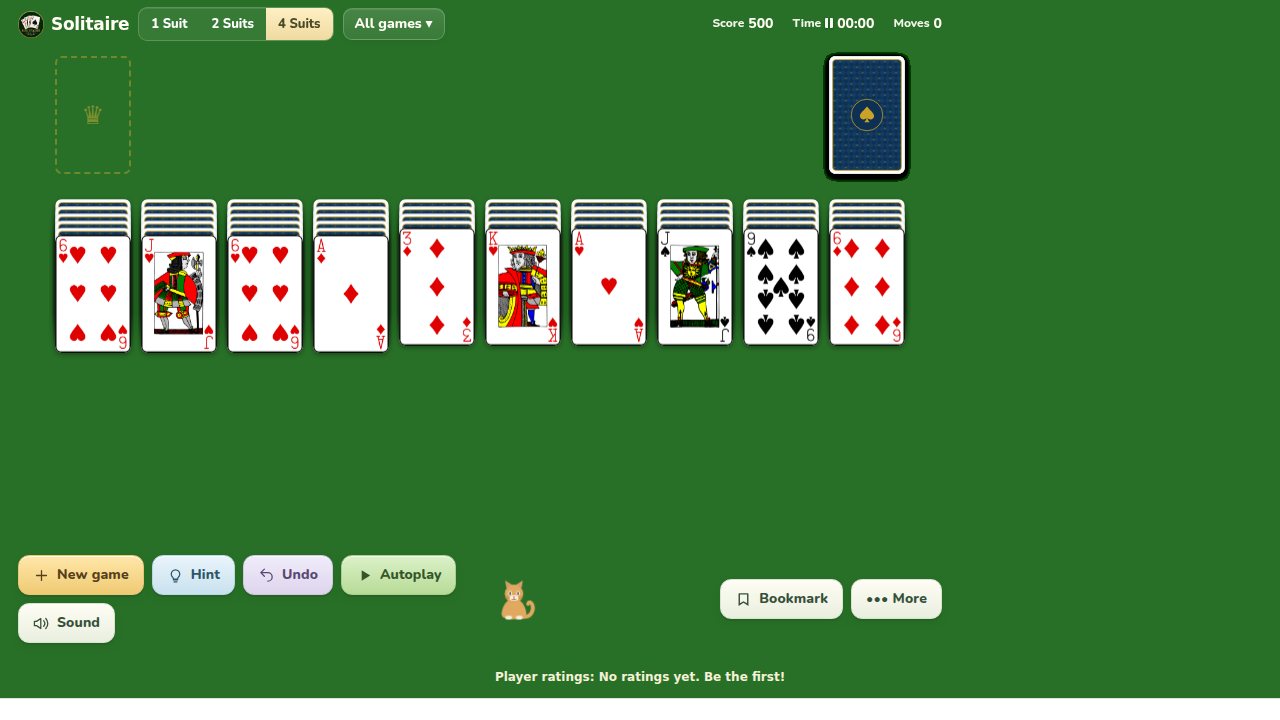 Solitaire
Spider Solitaire 4 Suits uses two full decks: hearts, diamonds, clubs and spades, with two copies of every card. Your goal is to remove eight complete runs, each running from King to Ace in one suit. This page starts a fresh game in four-suit mode, free in your browser, with hints and undo.
Rules · Screenshot · Strategy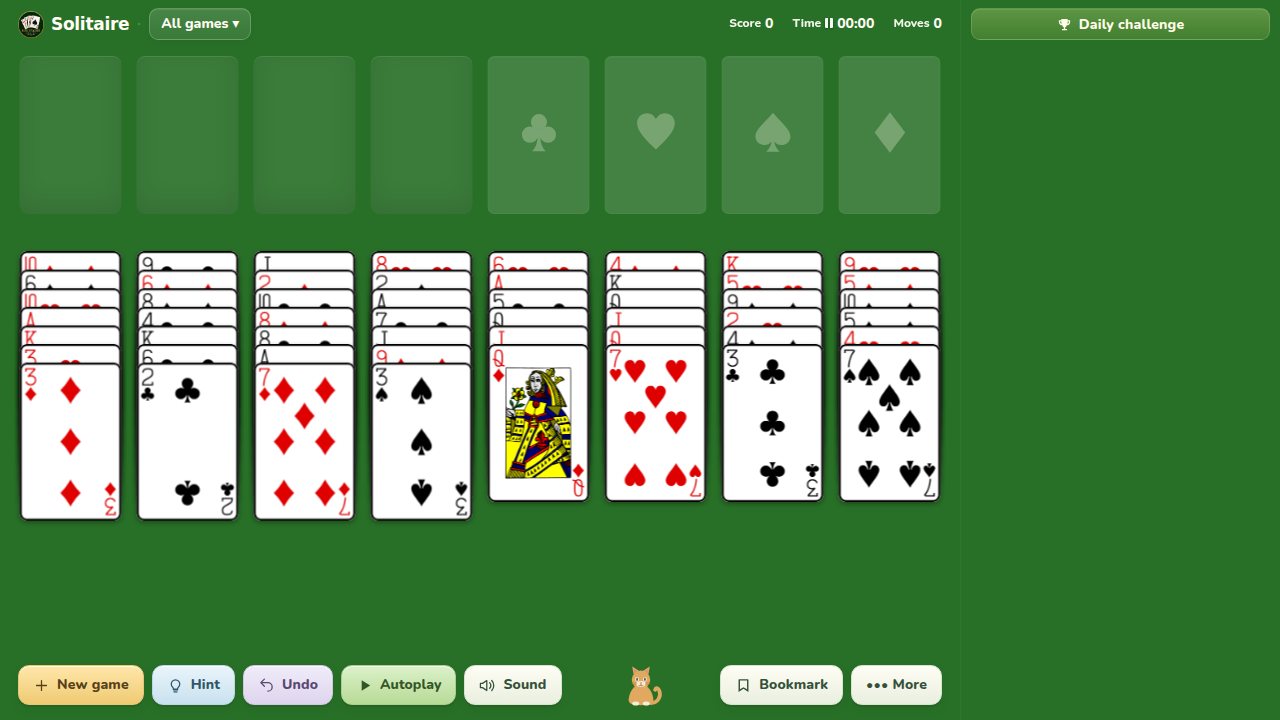 Solitaire
FreeCell is the solitaire with no secrets: all 52 cards are dealt face up from the very first moment, so nothing is left to luck. Four free cells, each a single-card parking space, give you just enough room to take a shuffled deck apart, and almost every deal can be won with careful play.
Rules · Screenshot · Strategy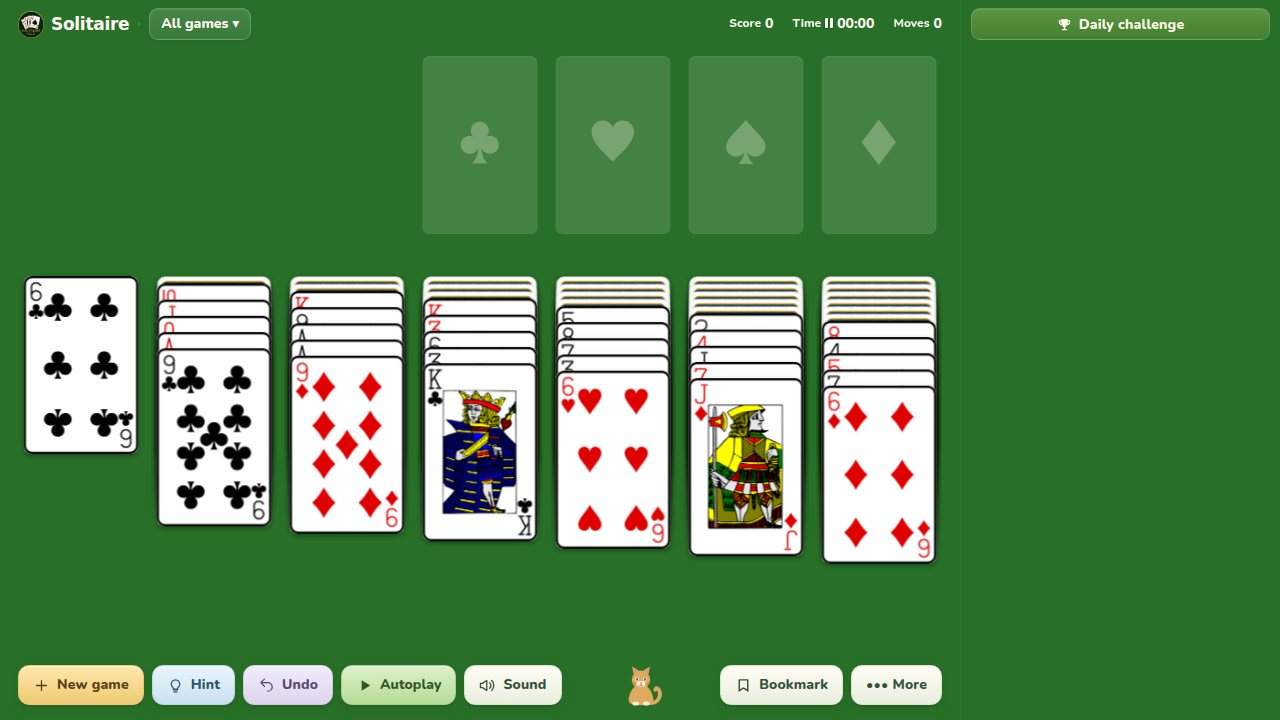 Solitaire
Yukon solitaire looks like Klondike at first glance, with seven columns, four foundations and alternating colours, but plays completely differently. Every card is dealt at the start (there is no stock pile), and you may pick up any face-up card along with everything stacked on top of it, whether or not those cards are in order.
Rules · Screenshot · Strategy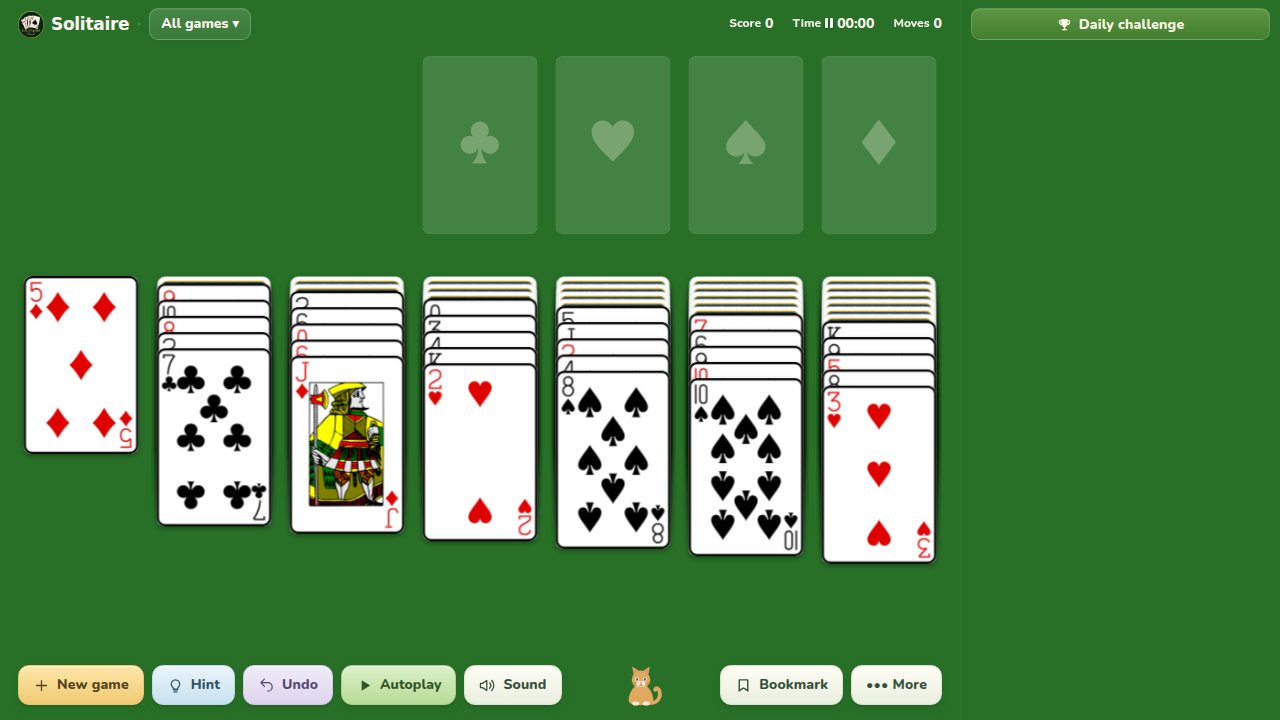 Solitaire
Russian solitaire is Yukon with the difficulty turned all the way up. The layout is identical, with every card dealt at the start, no stock pile and movable face-up groups, but the tableau builds down in the same suit instead of alternating colours. A 7 of spades will only ever accept the 6 of spades.
Rules · Screenshot · Strategy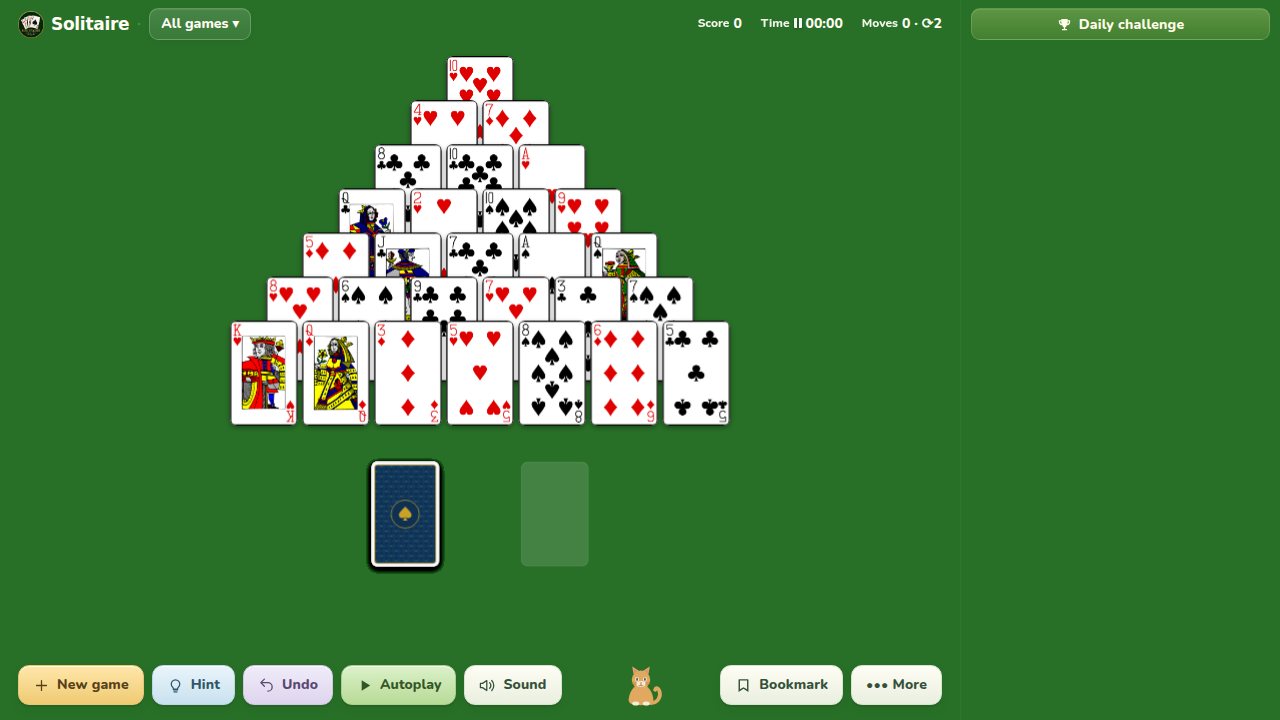 Solitaire
Pyramid swaps sequences for arithmetic: 28 cards are laid out in a seven-row pyramid, and you remove them in pairs that add up to thirteen. A Queen (12) needs an Ace, a Jack (11) needs a 2, a 10 needs a 3, while Kings, worth thirteen on their own, are removed alone with a single tap.
Rules · Screenshot · Strategy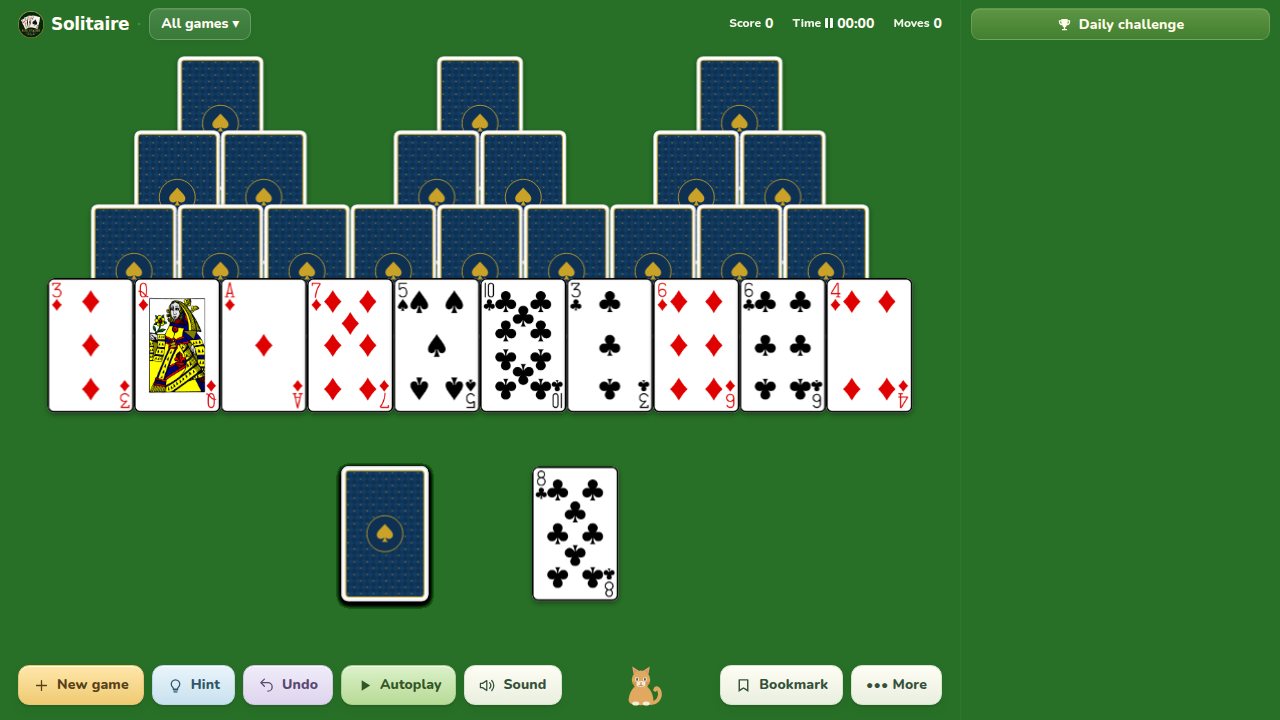 Solitaire
TriPeaks is the fastest game on this site: three card peaks, one waste pile, and a single question repeated at speed: is anything one rank above or below my current card? Play any open card that is one step up or down from the waste (the order wraps, so an Ace sits next to both a King and a 2), and chain those steps into long runs.
Rules · Screenshot · Strategy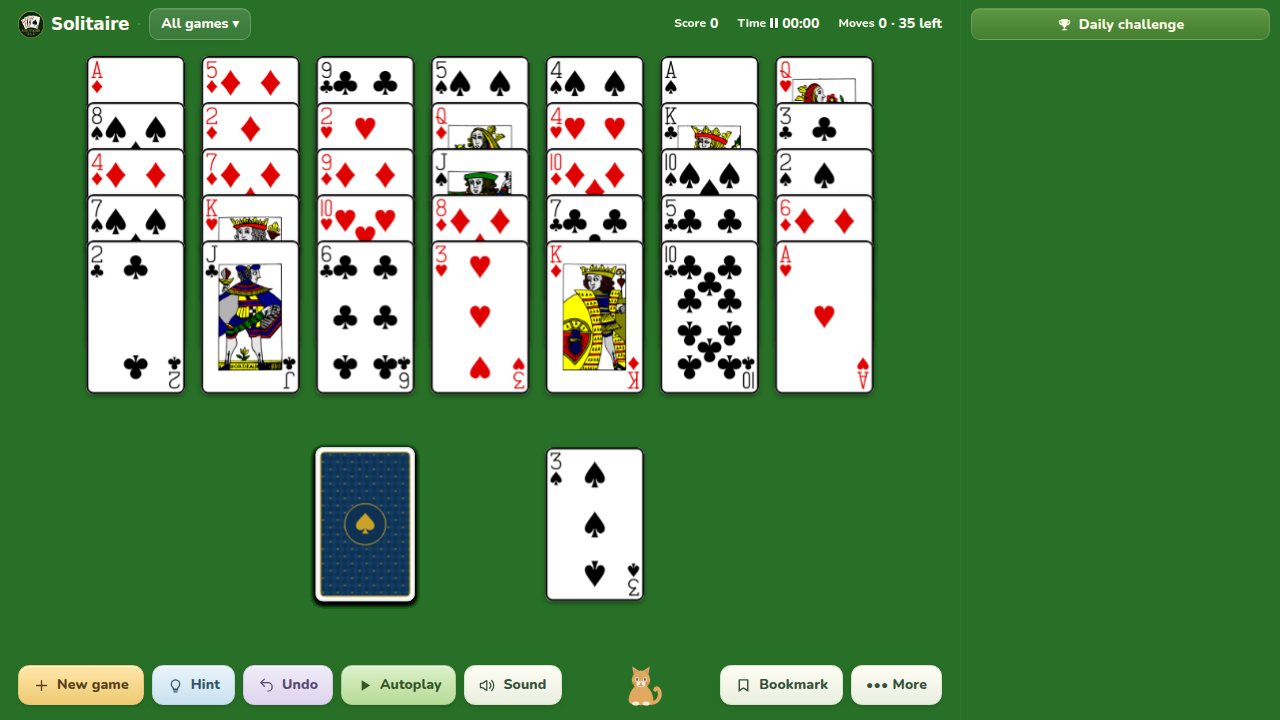 Solitaire
Golf solitaire deals seven columns of five cards, all face up, and challenges you to play them all onto the waste one rank up or down at a time. Like its namesake, the aim is a low score; every card left on the board at the end is a stroke against you.
Rules · Screenshot · Strategy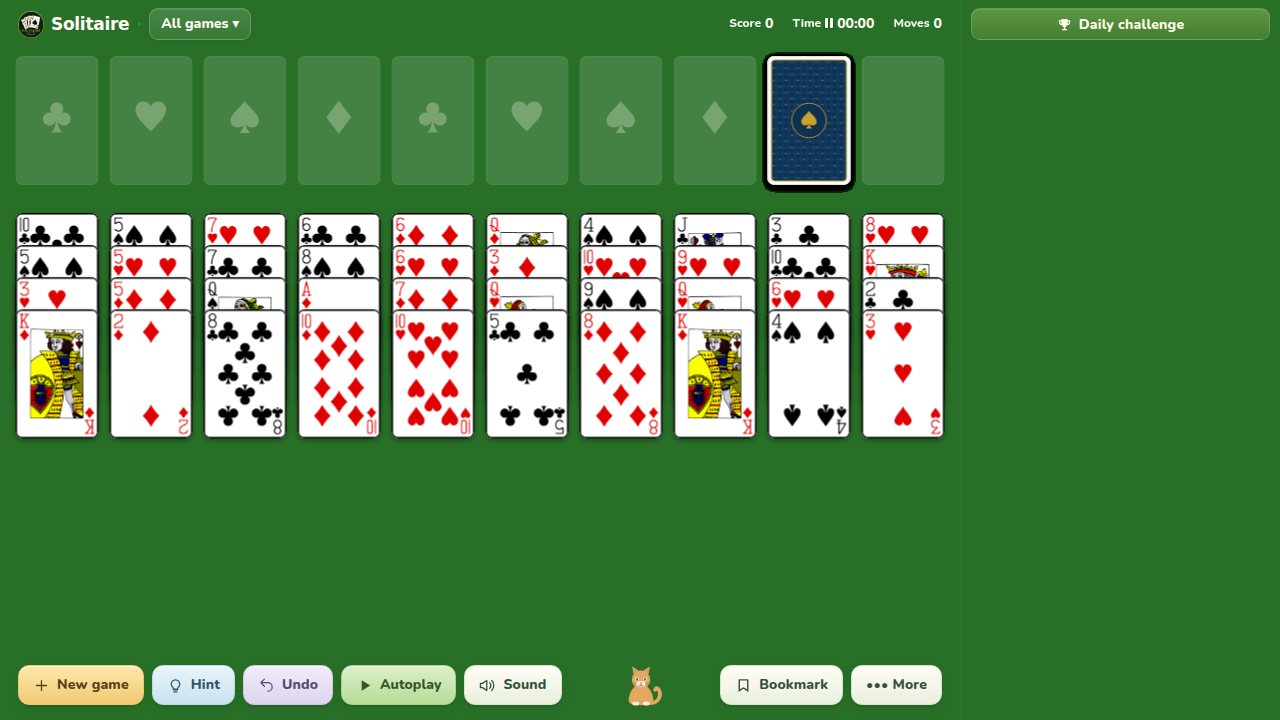 Solitaire
Forty Thieves Solitaire, also searched as 40 Thieves Solitaire, is the connoisseur's game: two full decks, ten columns of four cards, the forty thieves themselves, and rules that give you nothing for free. You build down in suit, move only one card at a time, and get a single pass through the stock with no redeal.
Rules · Screenshot · Strategy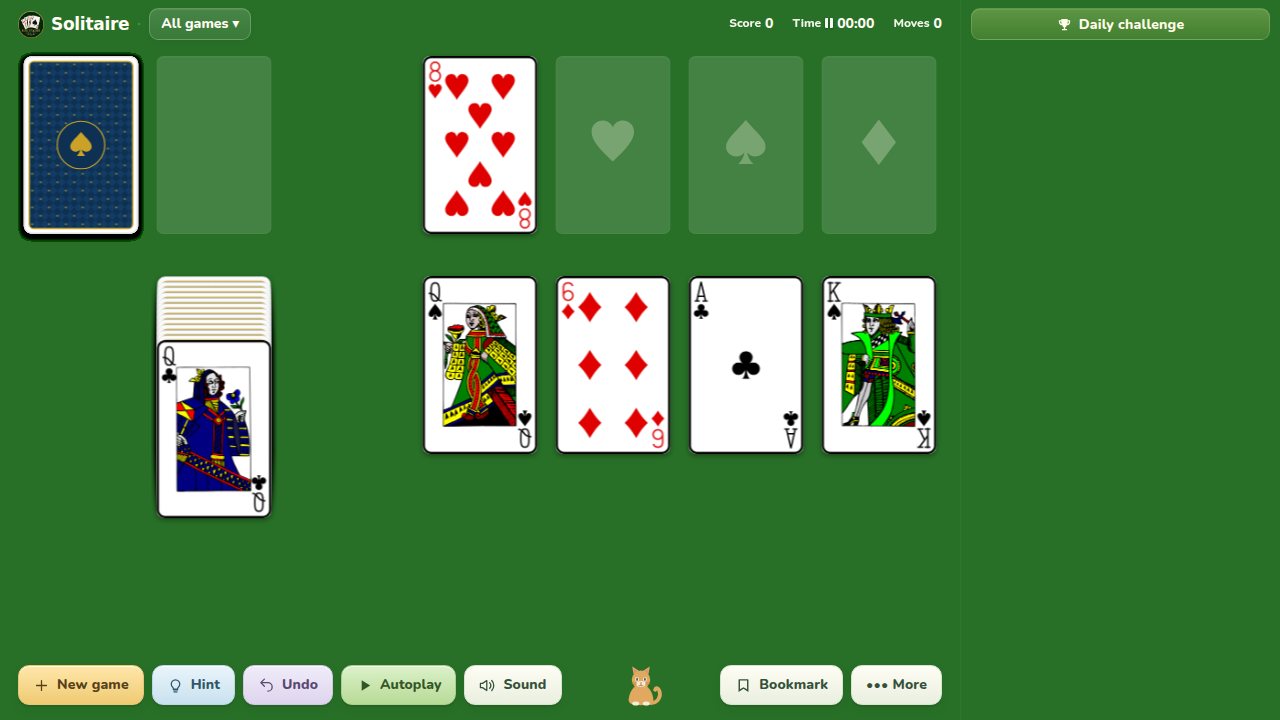 Solitaire
Canfield comes from an actual casino: in the 1890s, gamblers at Richard Canfield's Saratoga club bought a deck for $50 and won $5 back for every card they managed to play to the foundations. The house did famously well, which tells you what kind of game this is.
Rules · Screenshot · Strategy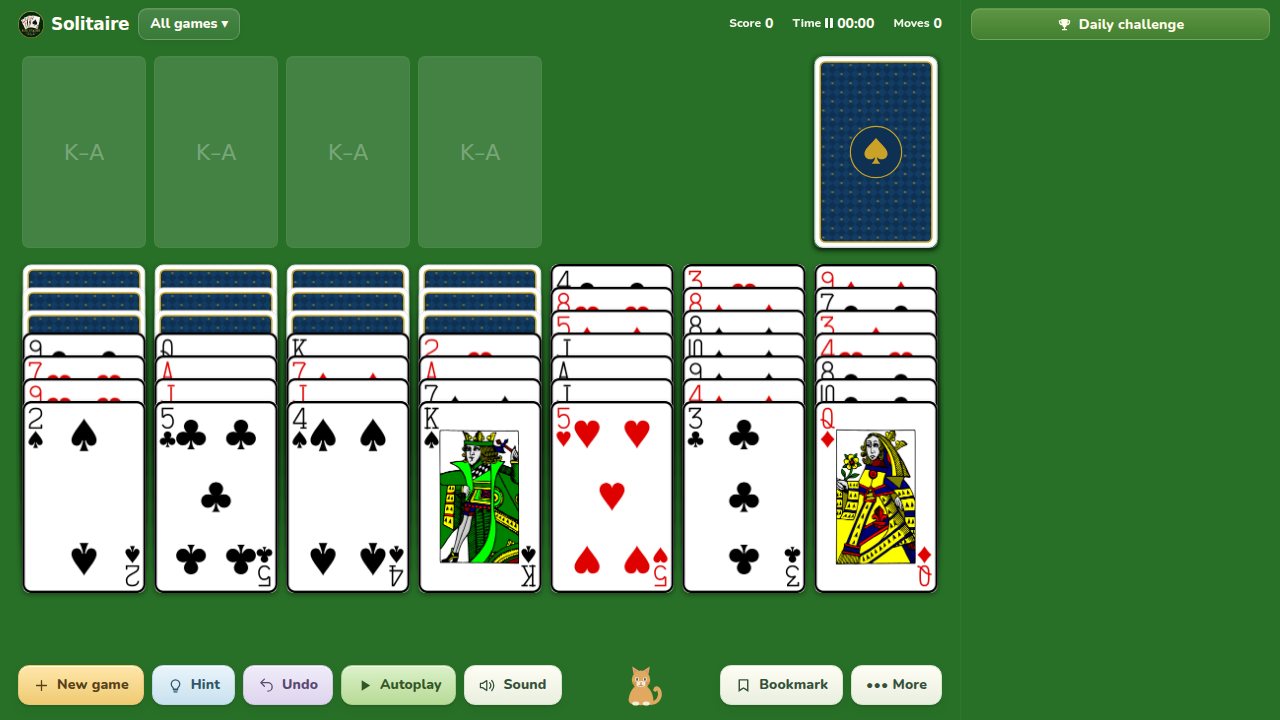 Solitaire
A tangled tableau, three reserve cards, and four suits to put in order. Enjoy the satisfaction of finishing a whole suit.
Rules · Screenshot · Strategy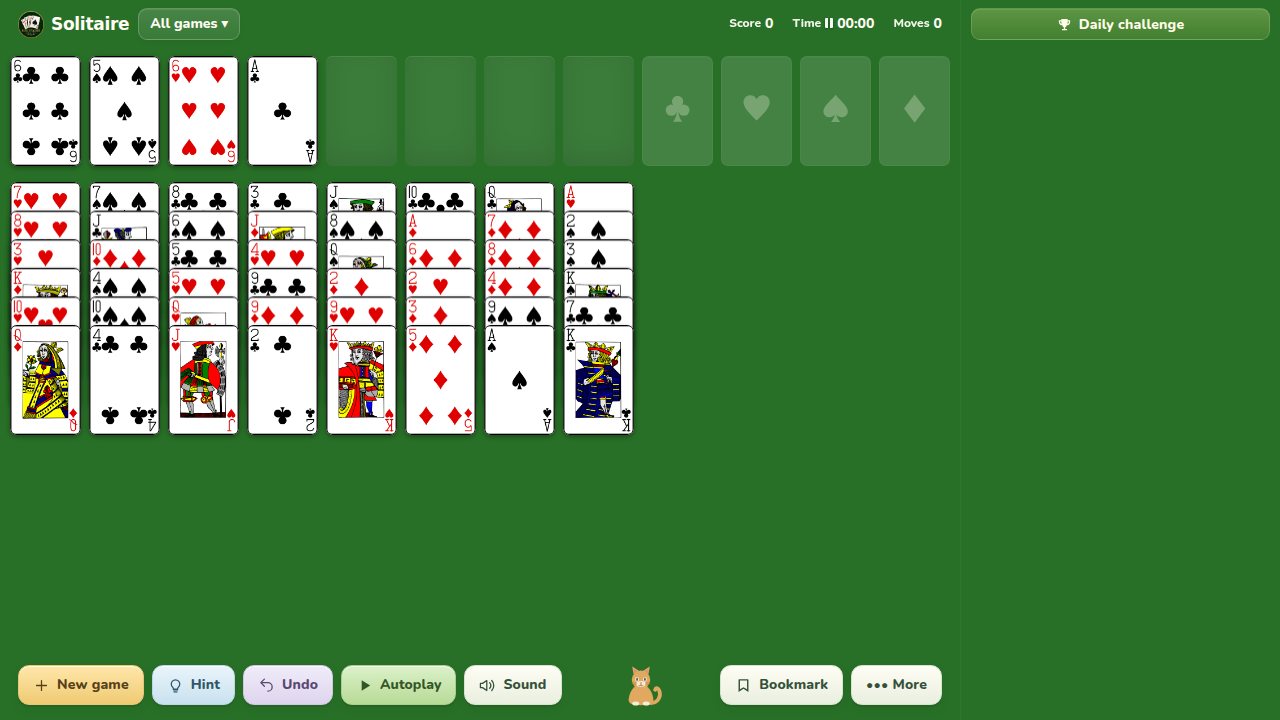 Solitaire
Eight reserve cells give every decision room to breathe. A fully visible deal rewards patient planning.
Rules · Screenshot · Strategy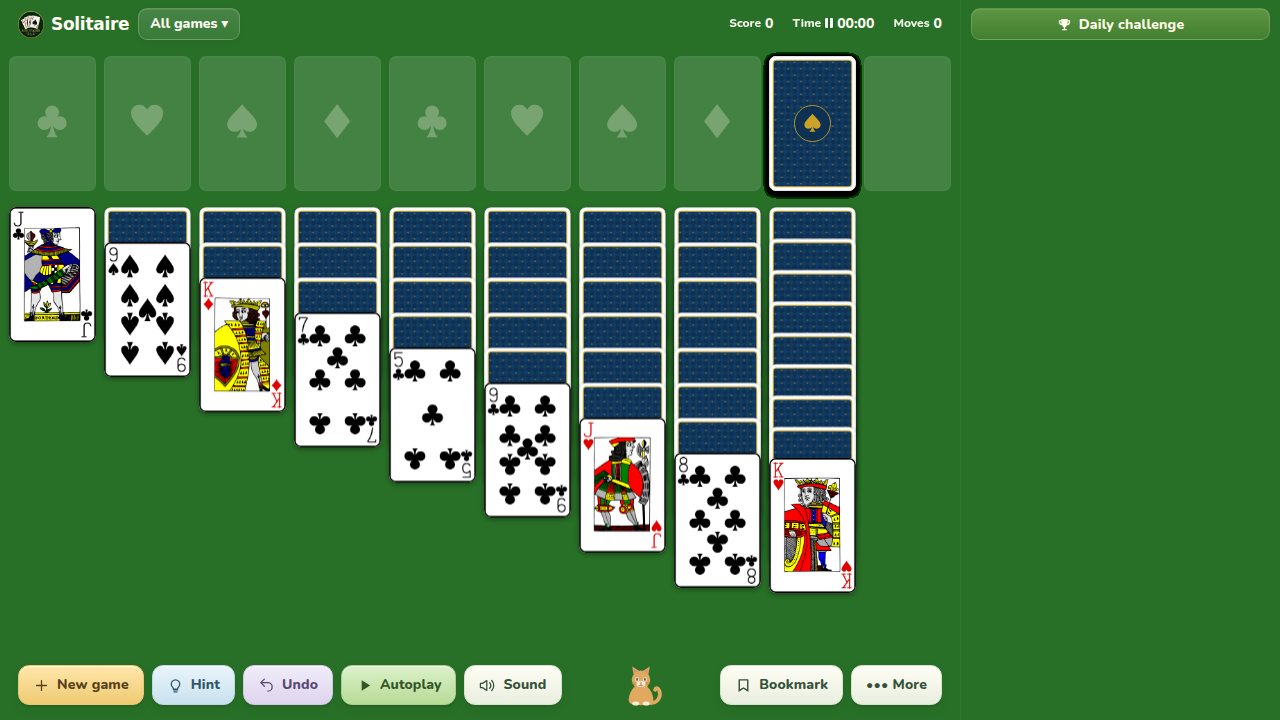 Solitaire
A bigger table for a familiar favorite. Two decks create more choices with classic alternating-color building.
Rules · Screenshot · Strategy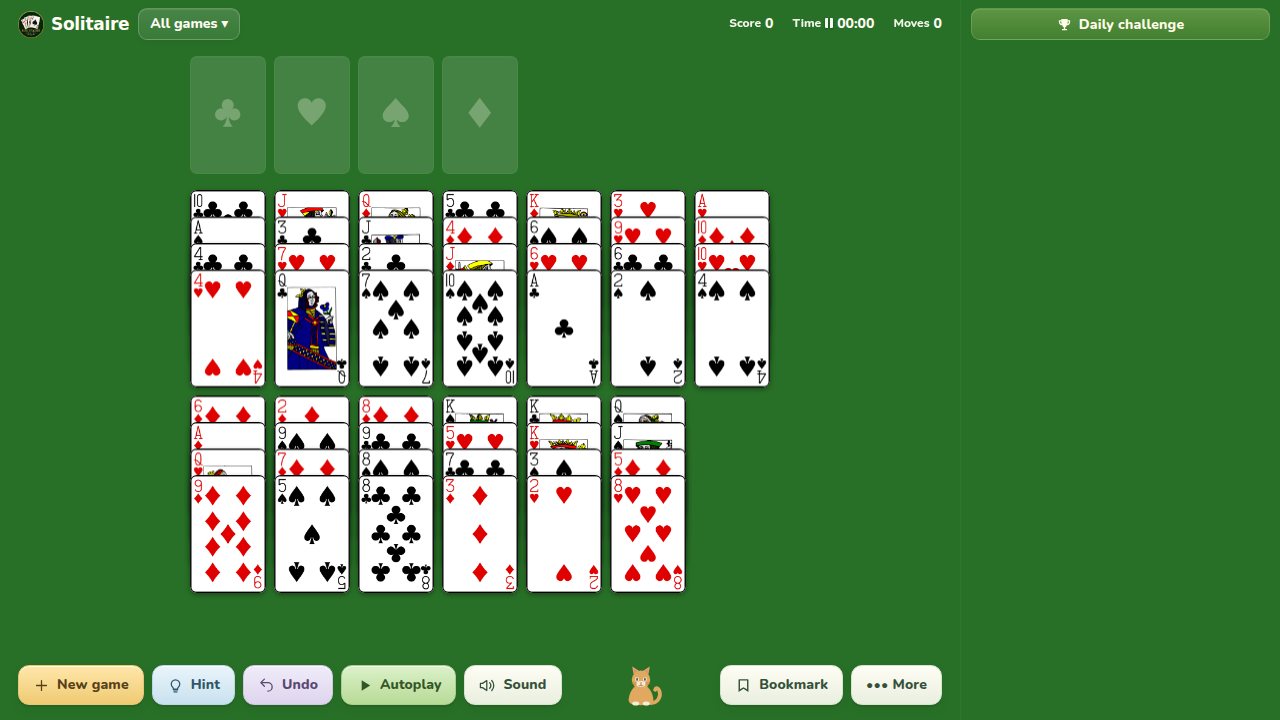 Solitaire
Thirteen small piles make an inviting open puzzle. Your next breakthrough is already somewhere on the table.
Rules · Screenshot · Strategy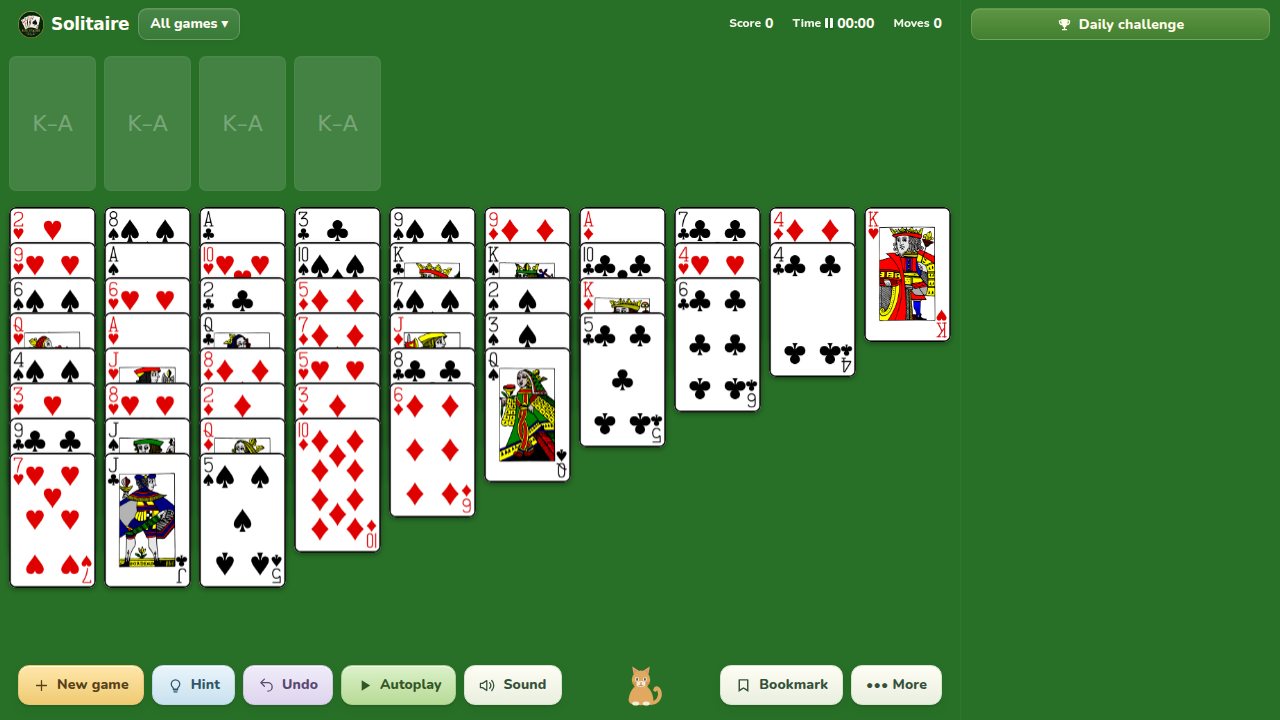 Solitaire
One deck, every card visible, and no stock to interrupt your plan. Enjoy Spider-style satisfaction in a thoughtful puzzle.
Rules · Screenshot · Strategy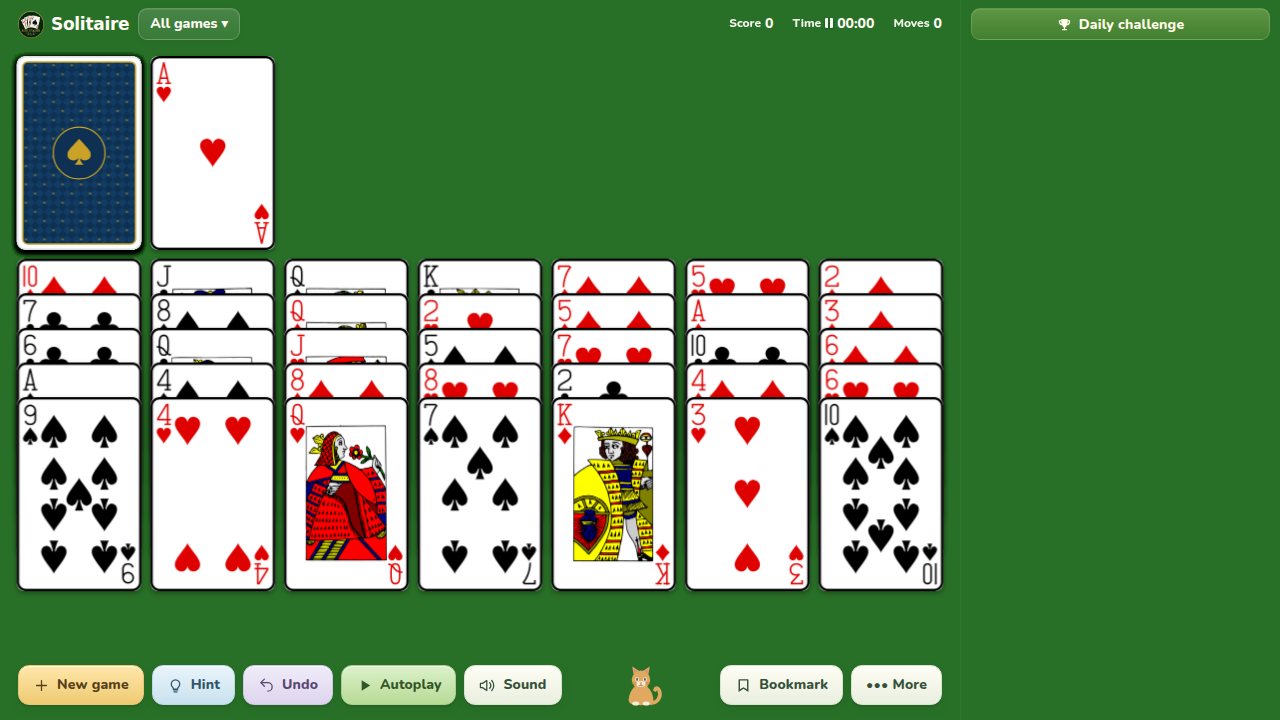 Solitaire
Golf with more freedom: Kings and Aces connect, letting a good run keep going.
Rules · Screenshot · Strategy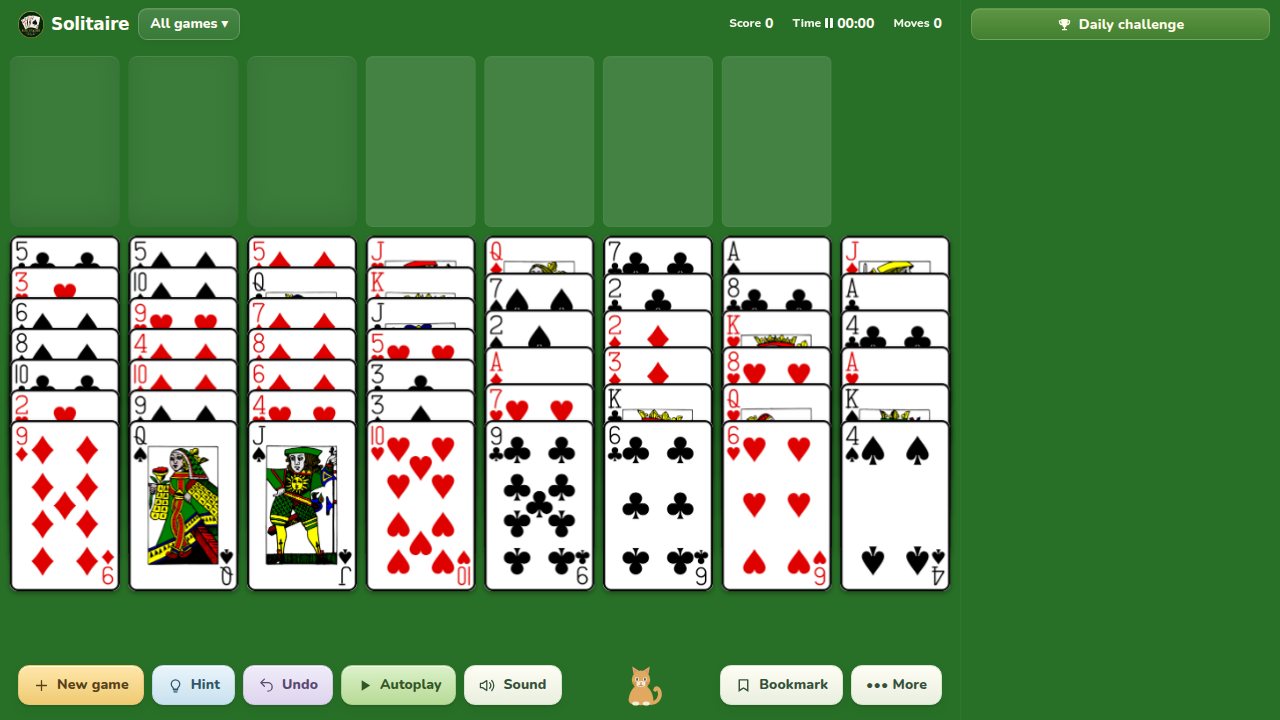 Solitaire
FreeCell with just three spare cells. Every open space matters a little more.
Rules · Screenshot · Strategy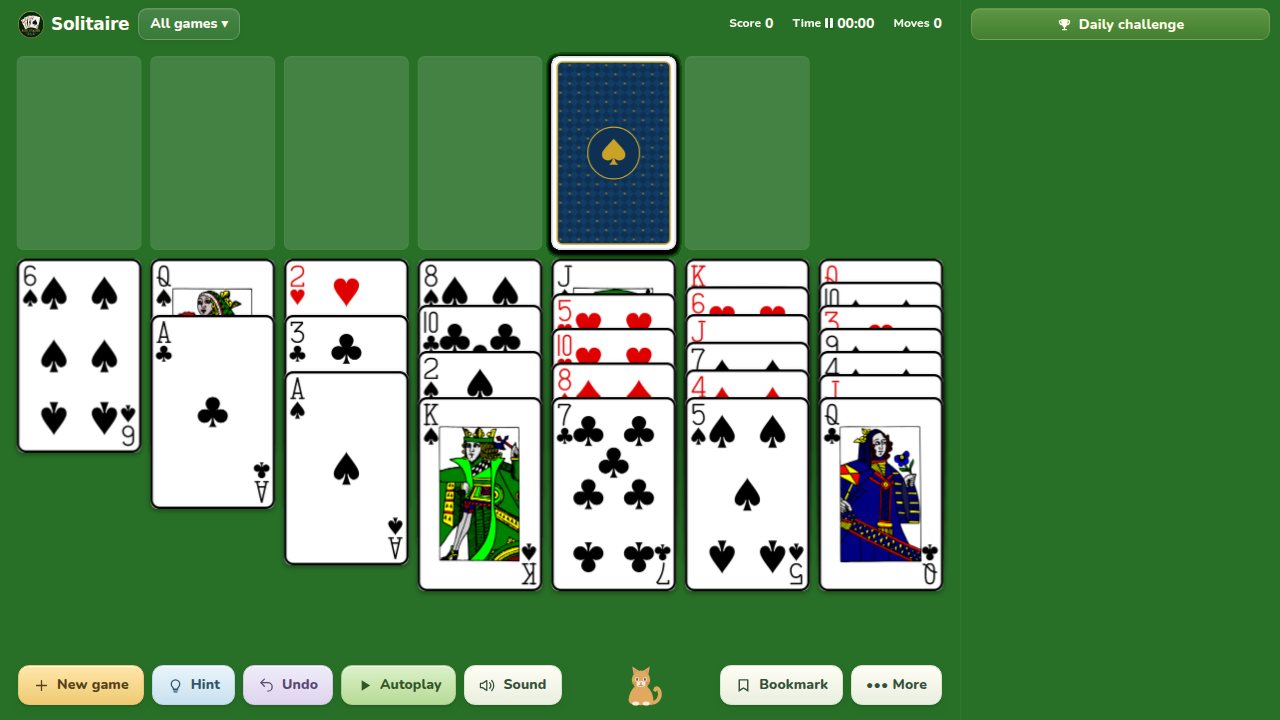 Solitaire
See the whole Klondike tableau from the first move and plan your route through it.
Rules · Screenshot · Strategy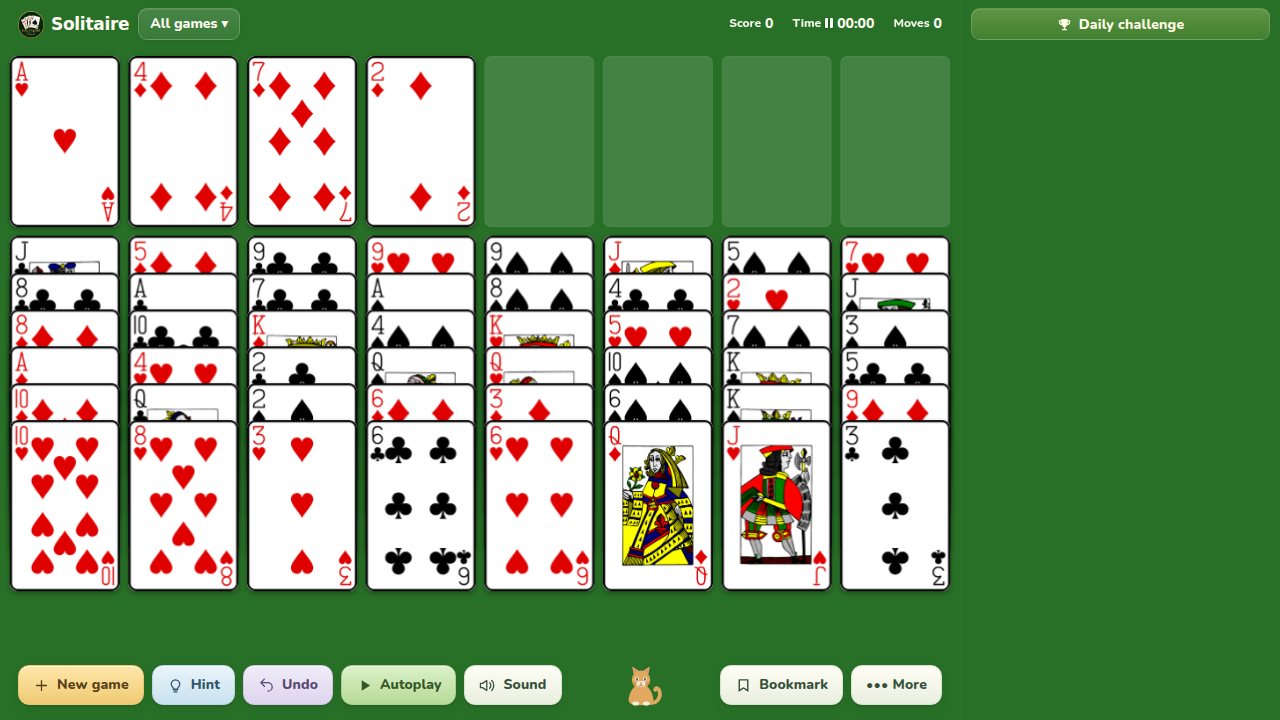 Solitaire
Four occupied cells and eight open columns turn a familiar deal into a tighter puzzle.
Rules · Screenshot · Strategy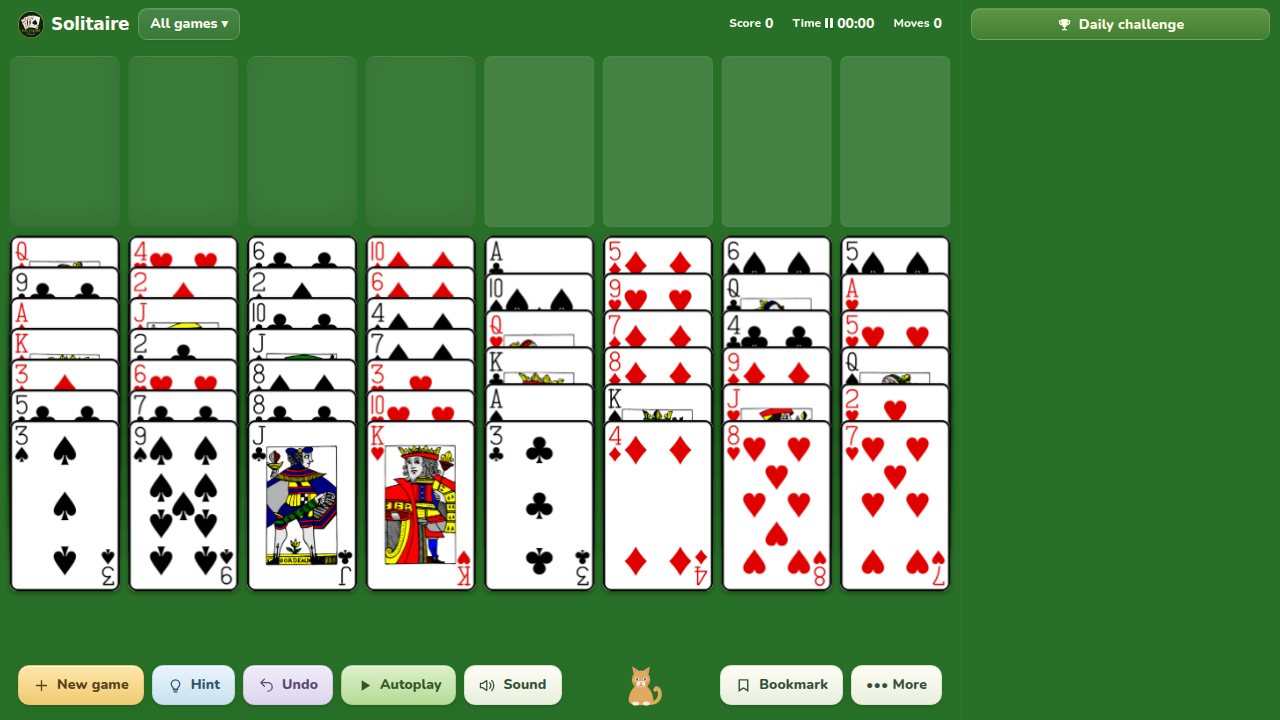 Solitaire
The familiar FreeCell board with same-suit building and four cells for careful rearrangements.
Rules · Screenshot · Strategy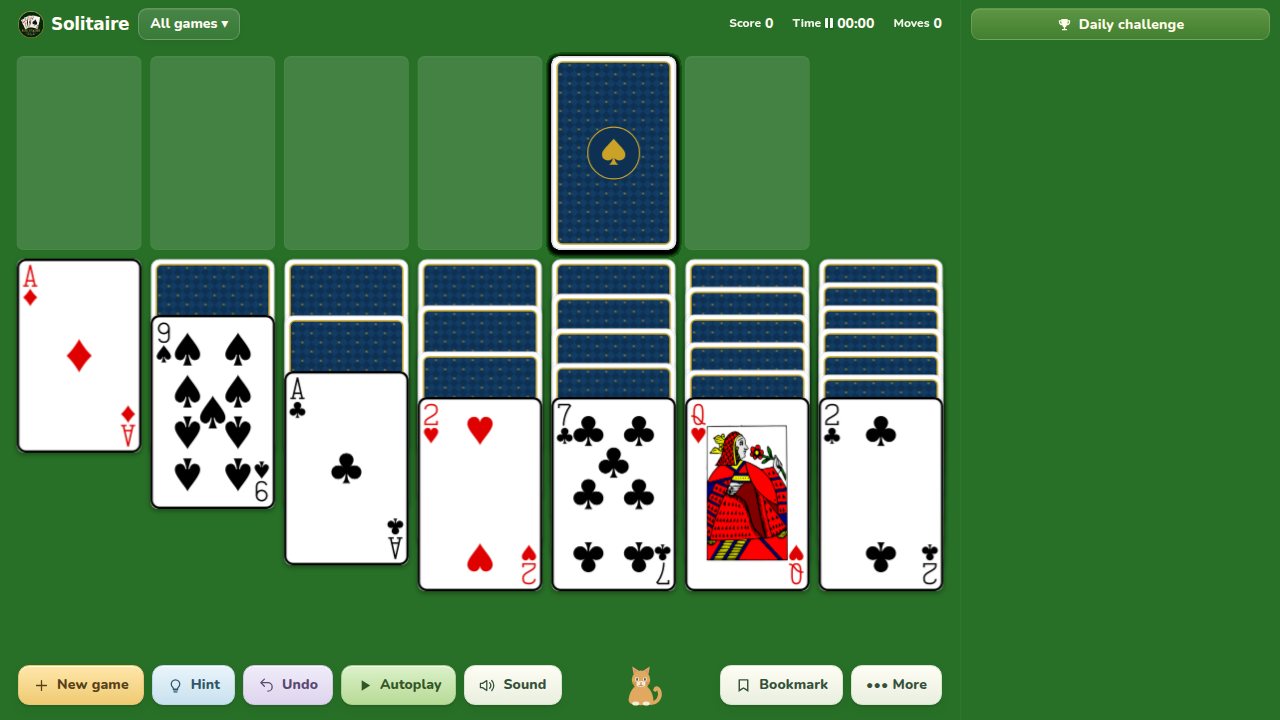 Solitaire
Klondike takes a stricter turn: every tableau sequence must stay in one suit.
Rules · Screenshot · Strategy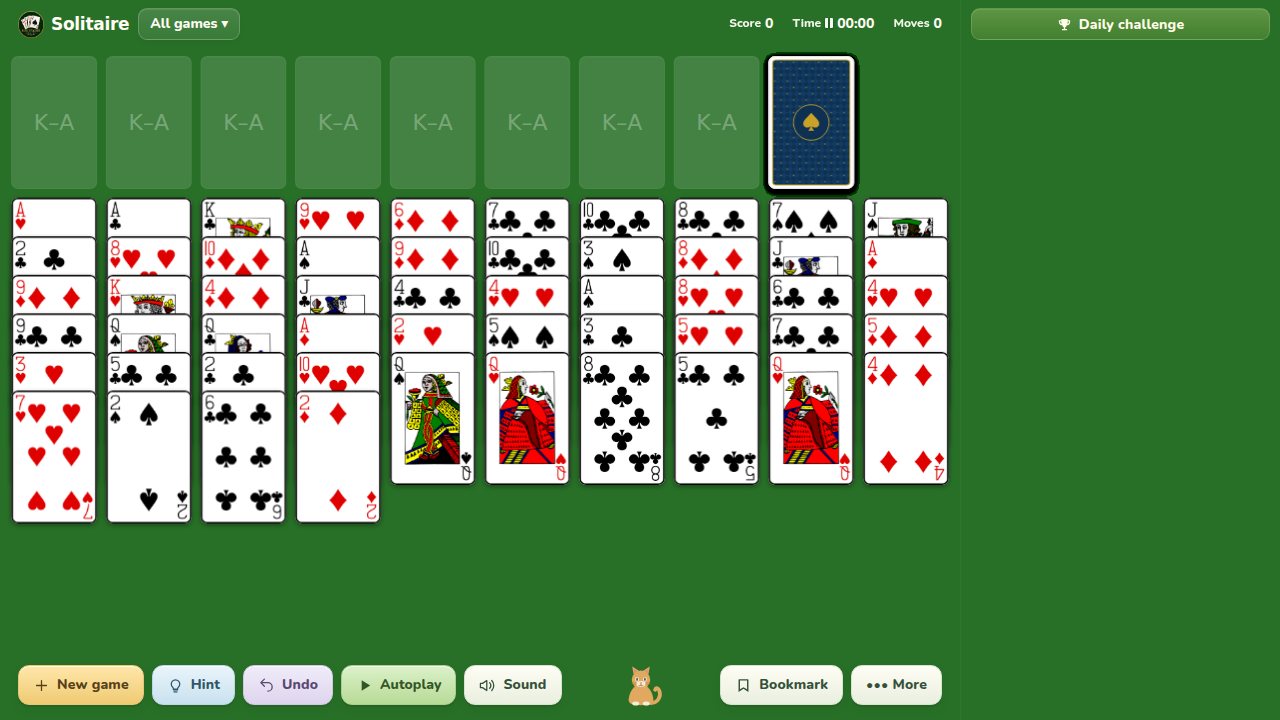 Solitaire
Two decks of Spider with every tableau card visible. Study the board and plan ahead.
Rules · Screenshot · Strategy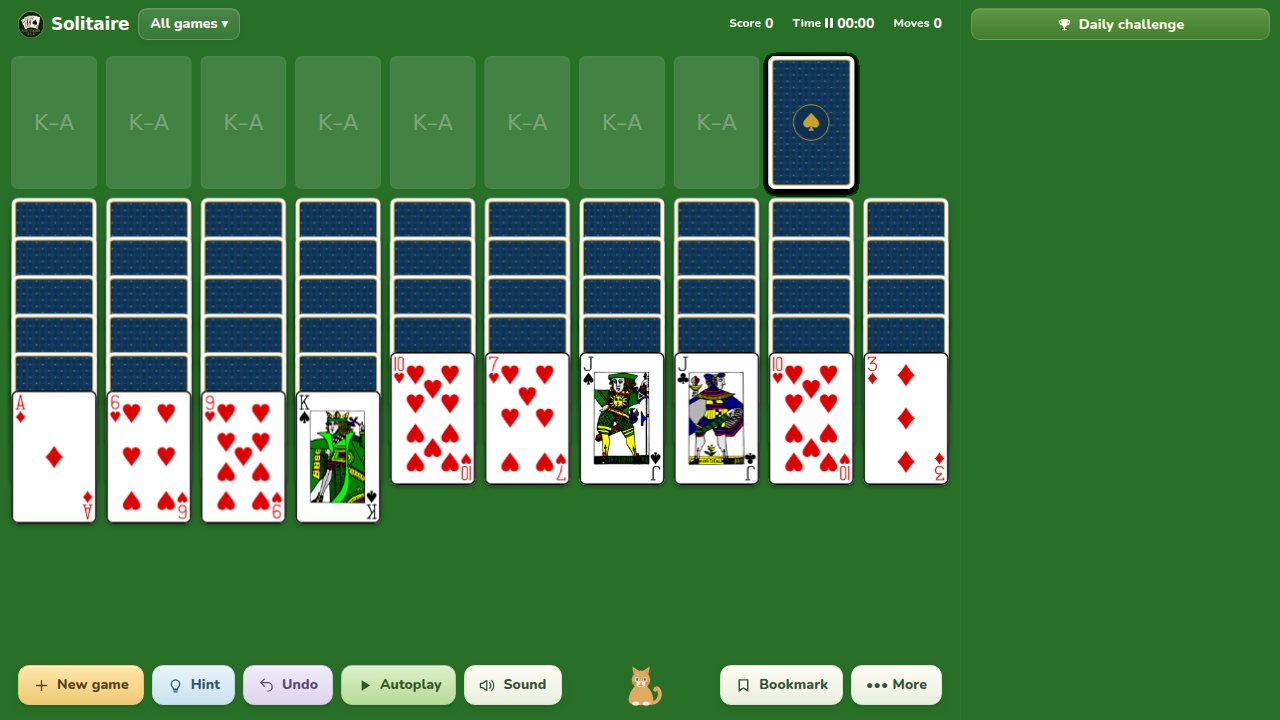 Solitaire
Spider with freer movement: any descending run can travel together, even across different suits.
Rules · Screenshot · Strategy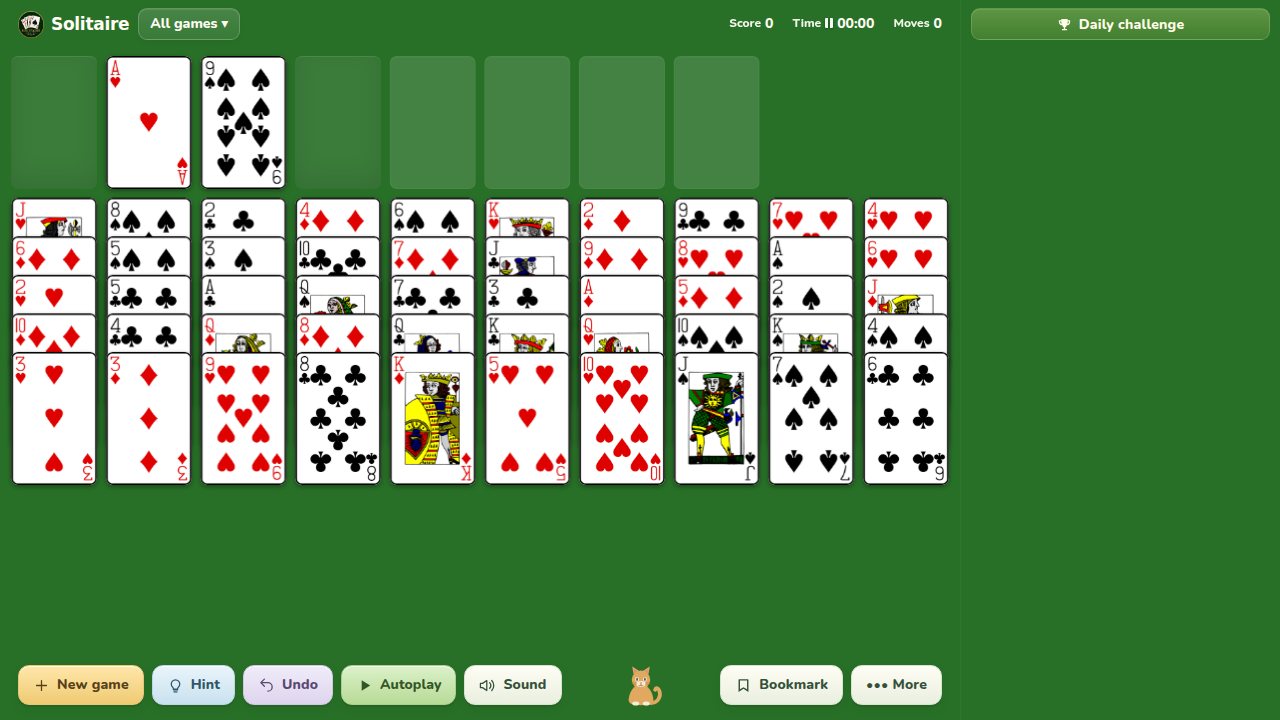 Solitaire
Ten compact columns, four reserve cells, and a same-suit puzzle laid out in full.
Rules · Screenshot · Strategy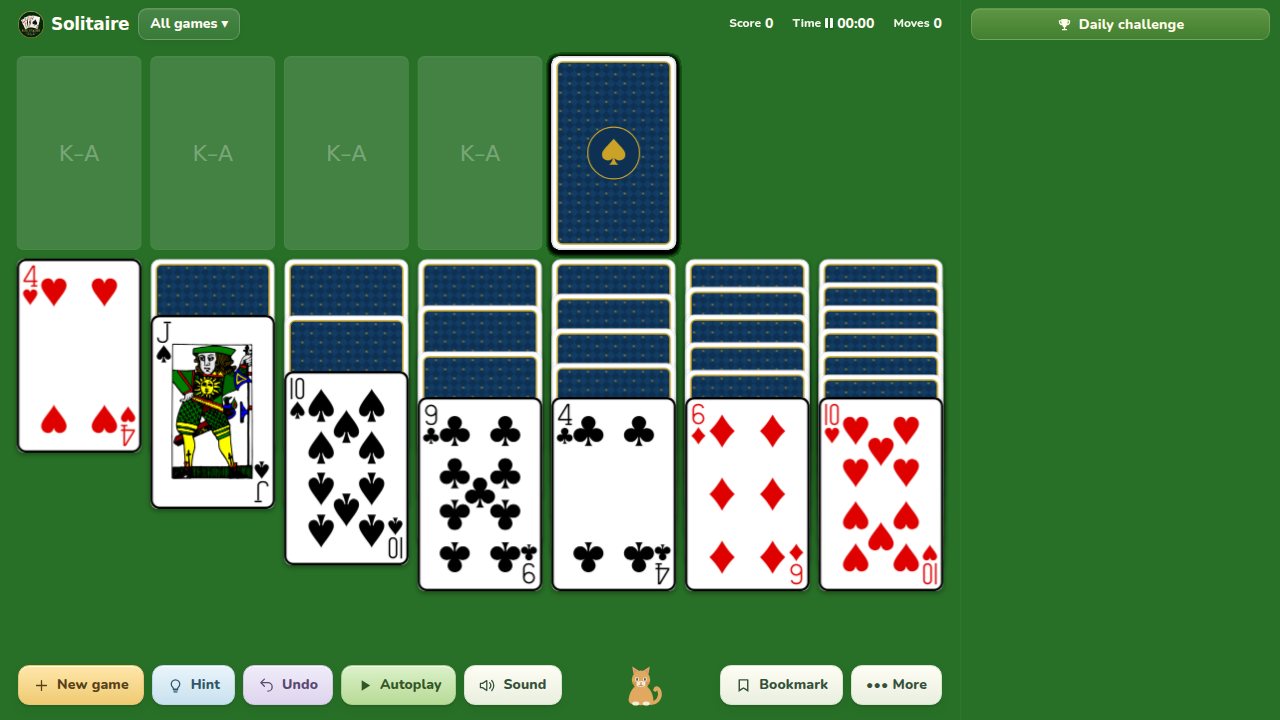 Solitaire
Spider’s suit-building challenge on a seven-column staircase with just one deck.
Rules · Screenshot · Strategy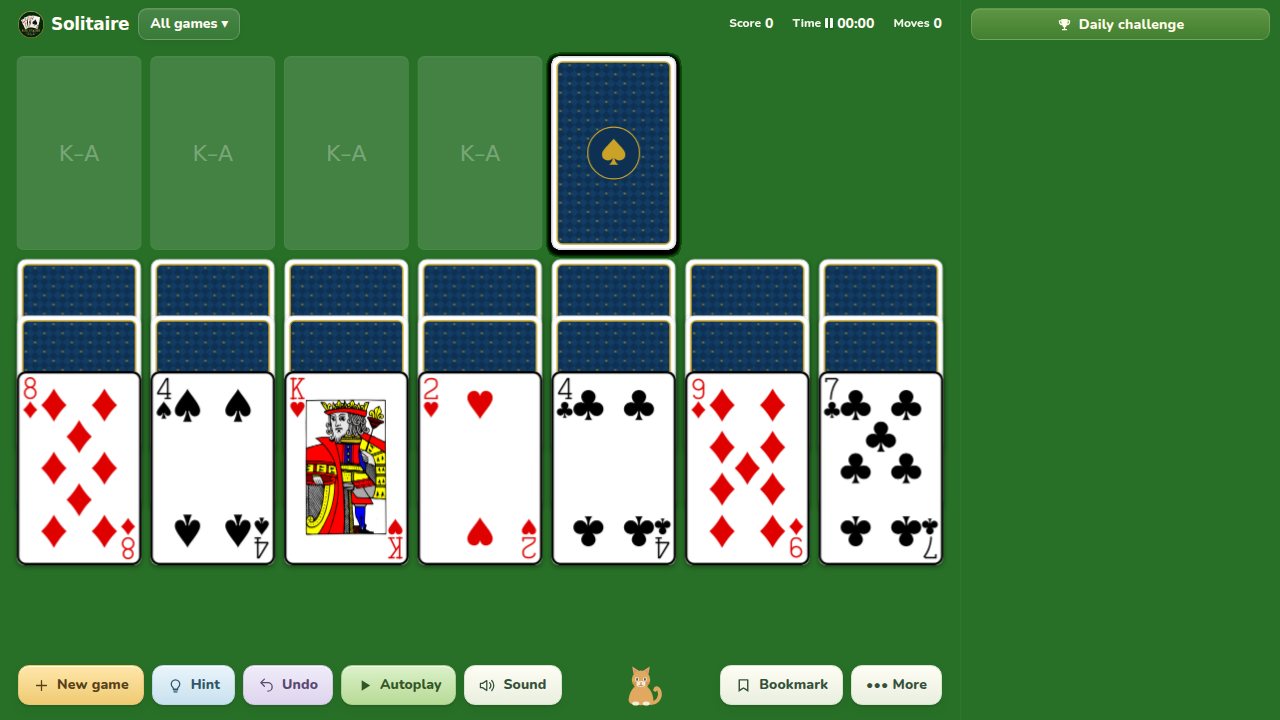 Solitaire
A small Spider board with seven equal columns, hidden cards, and four suits to untangle.
Rules · Screenshot · Strategy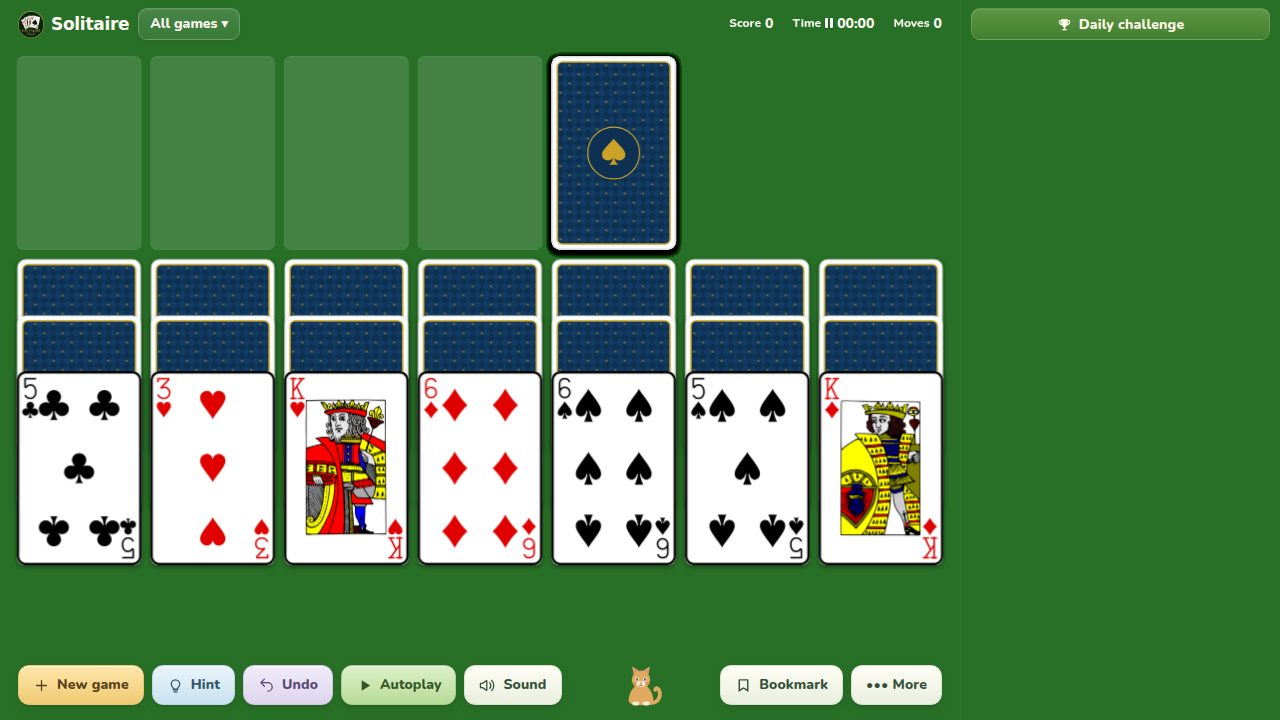 Solitaire
Klondike-style building meets row-by-row stock deals. Every draw changes the whole board.
Rules · Screenshot · Strategy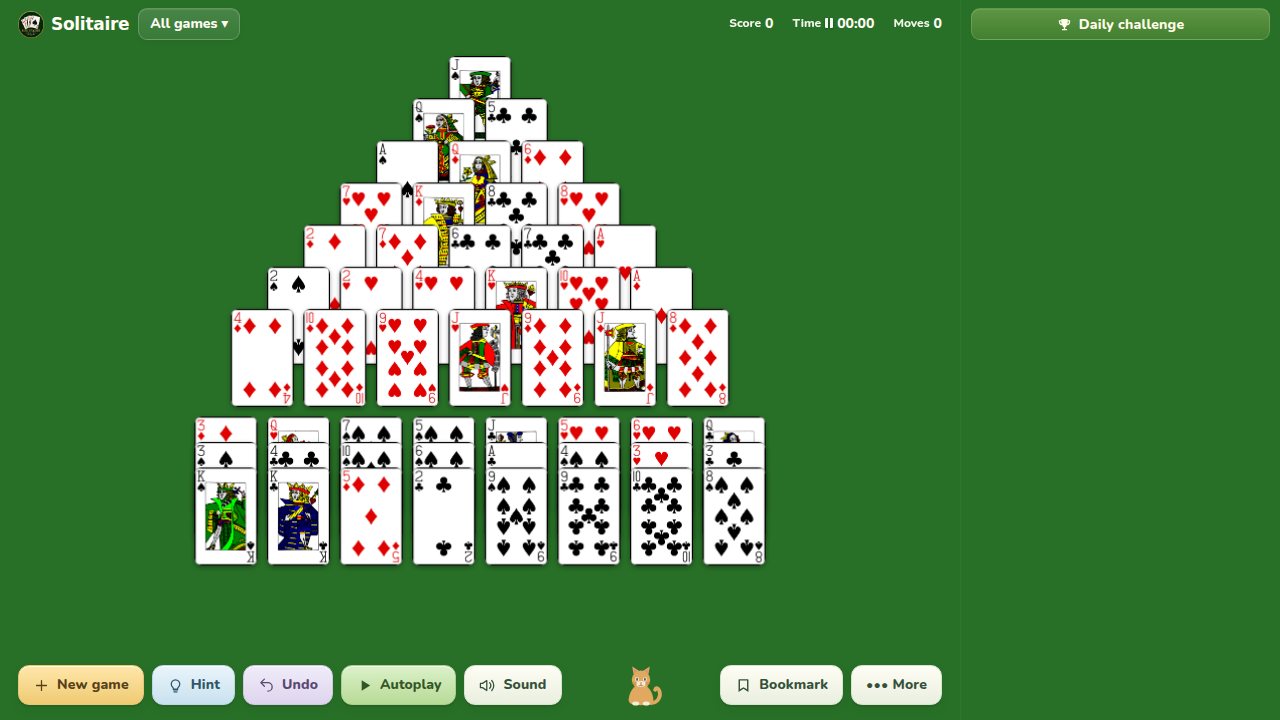 Solitaire
An open Pyramid puzzle with eight reserve fans. Every card is visible from the start.
Rules · Screenshot · Strategy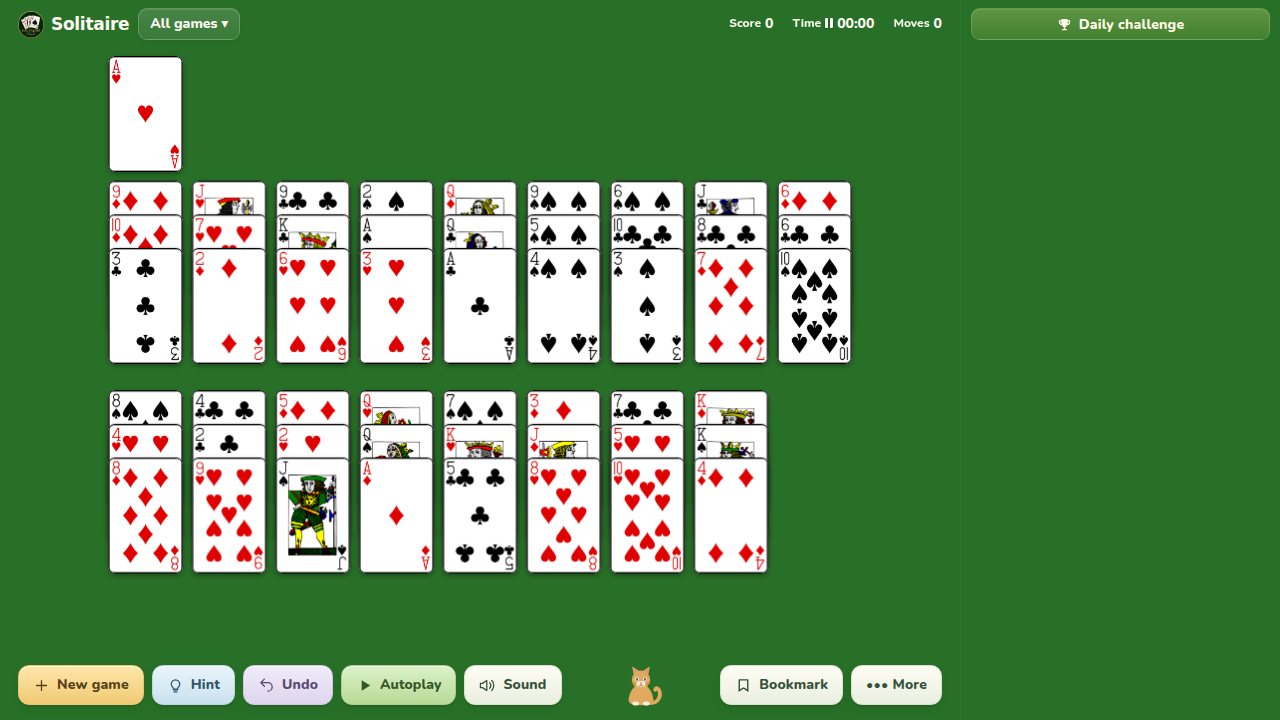 Solitaire
Seventeen open fans feed a single pile. Find a path through every card, one rank at a time.
Rules · Screenshot · Strategy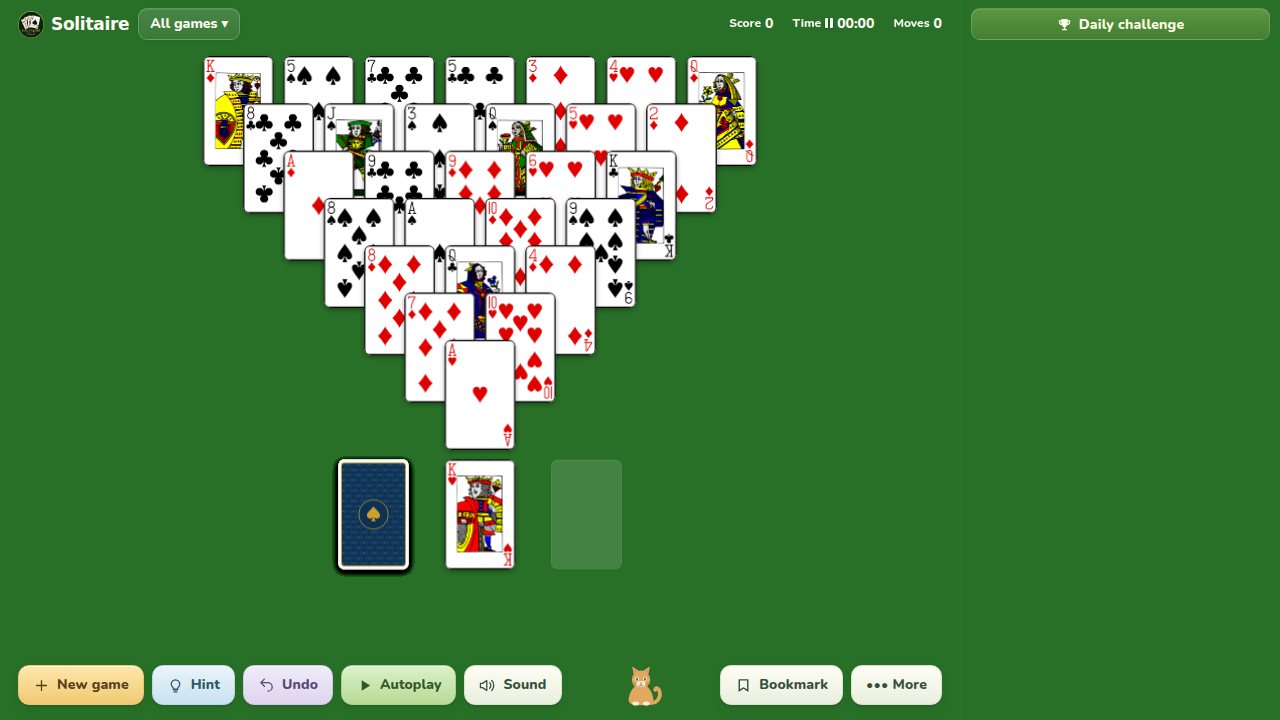 Solitaire
Pyramid turned upside down. Release its overlapping cards with pairs that total thirteen.
Rules · Screenshot · Strategy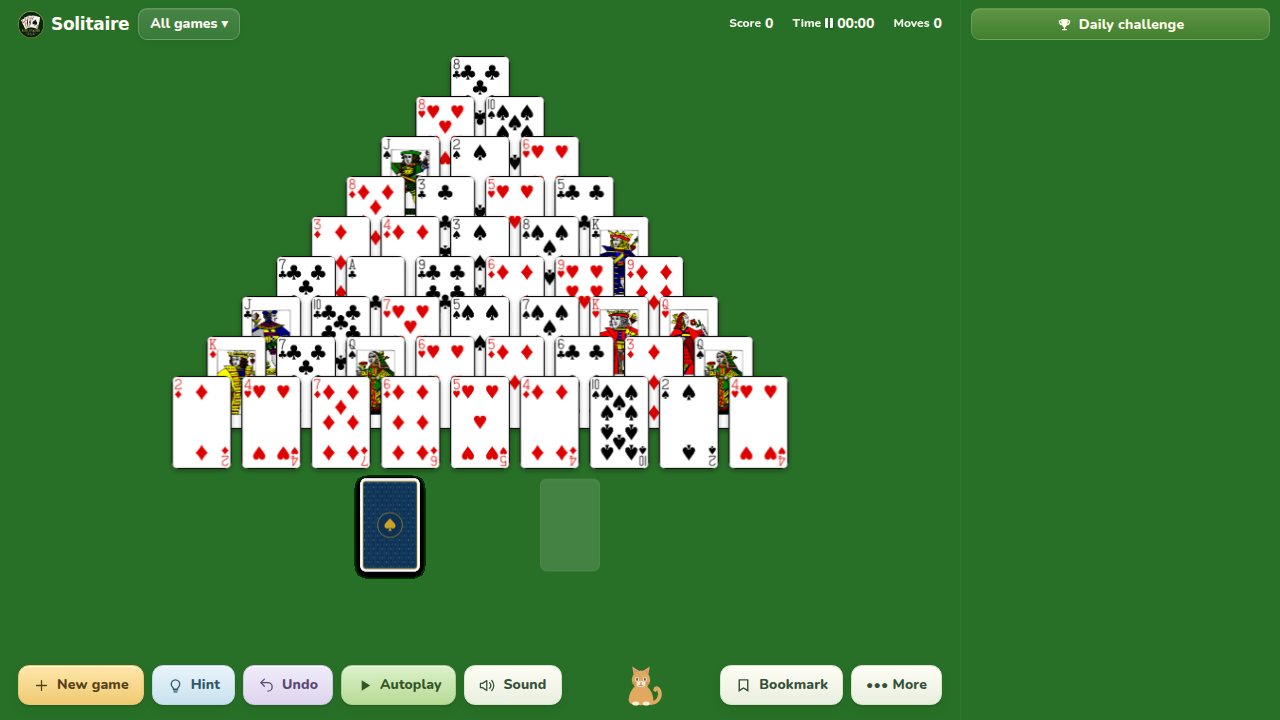 Solitaire
A larger nine-row pyramid and two full decks bring more choices to thirteen-point pairing.
Rules · Screenshot · Strategy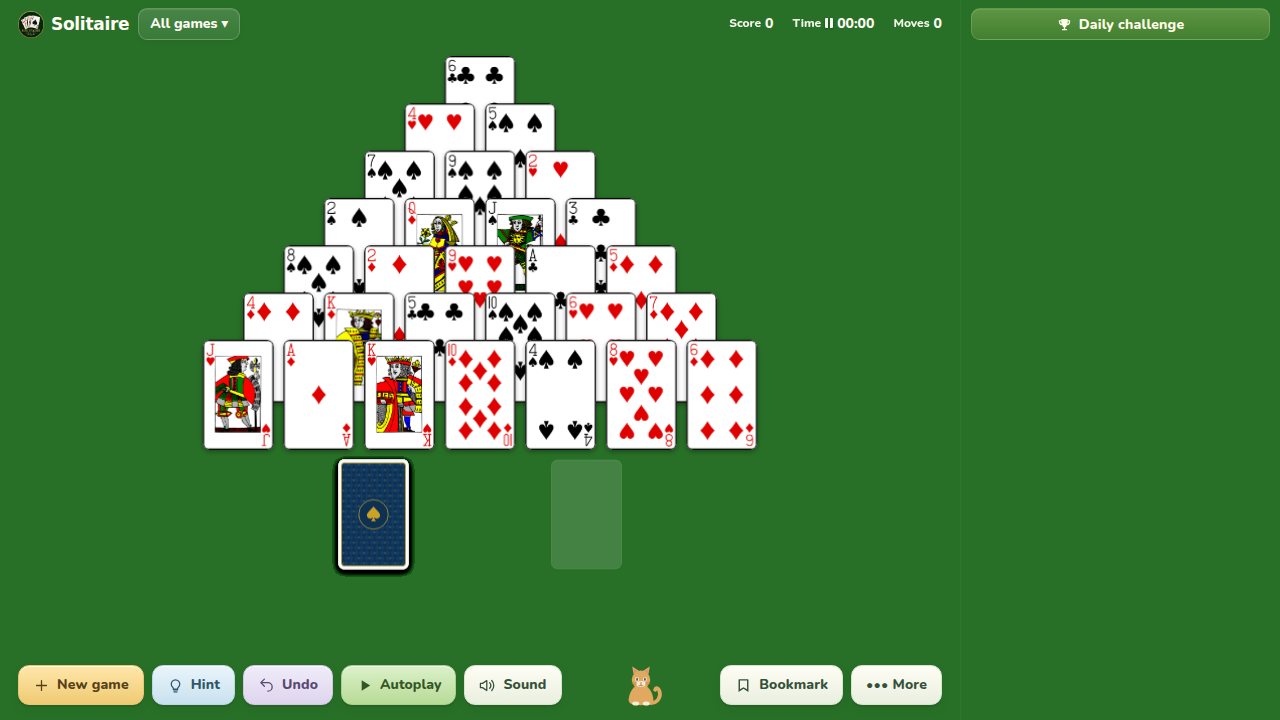 Solitaire
Pyramid with Draw 3 and unlimited stock passes. Time your pairs to open new waste cards.
Rules · Screenshot · Strategy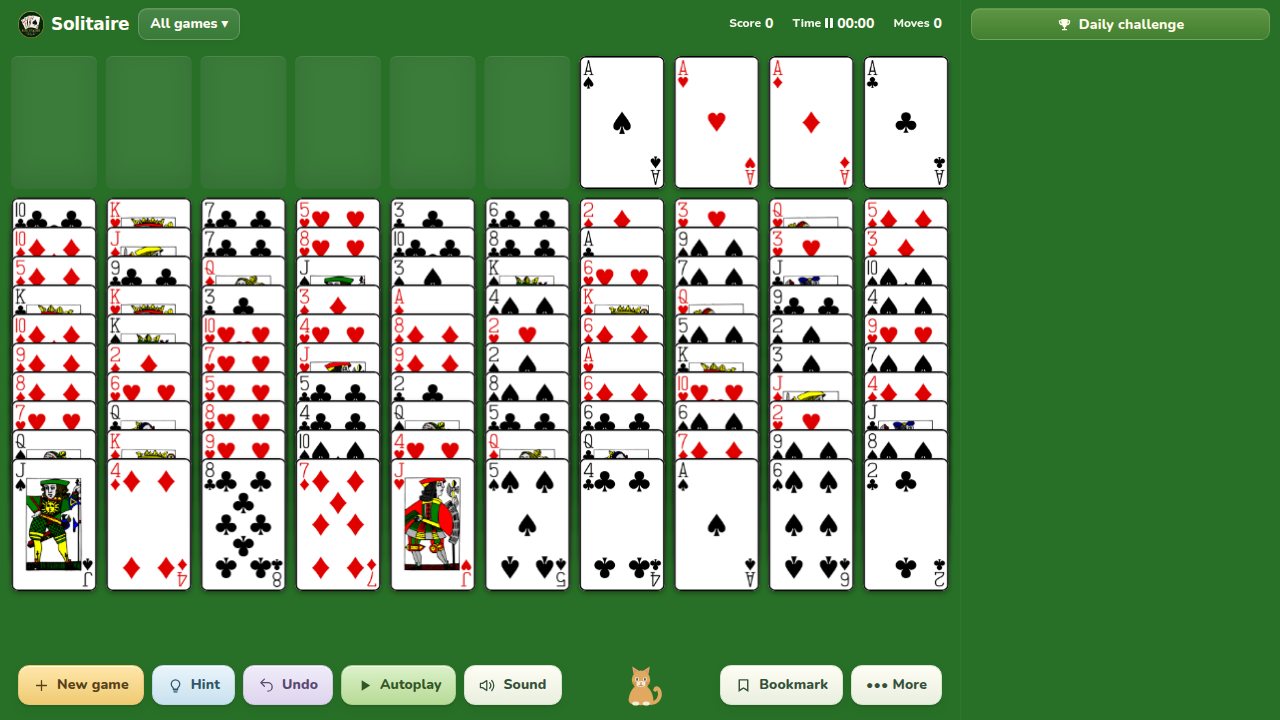 Solitaire
Two decks, six cells, and four foundations that each travel from Ace to King twice.
Rules · Screenshot · Strategy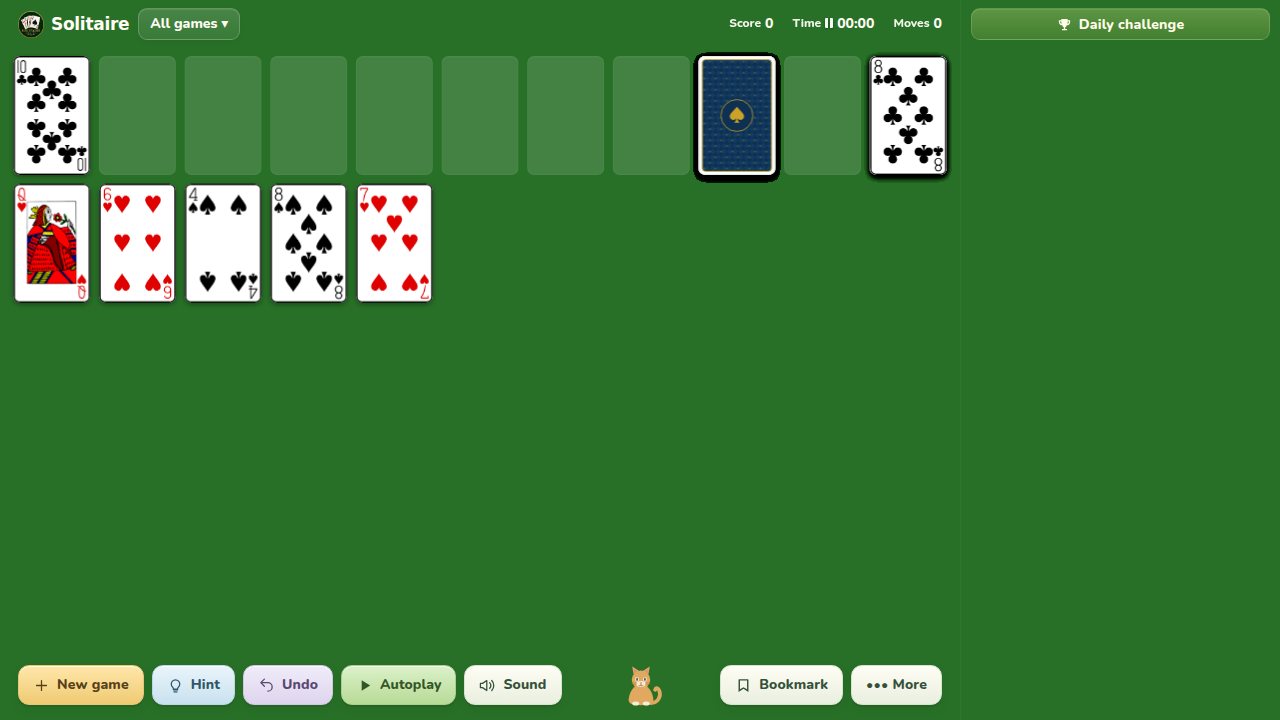 Solitaire
Two-deck Canfield with five columns, a thirteen-card reserve, and a changing foundation rank.
Rules · Screenshot · Strategy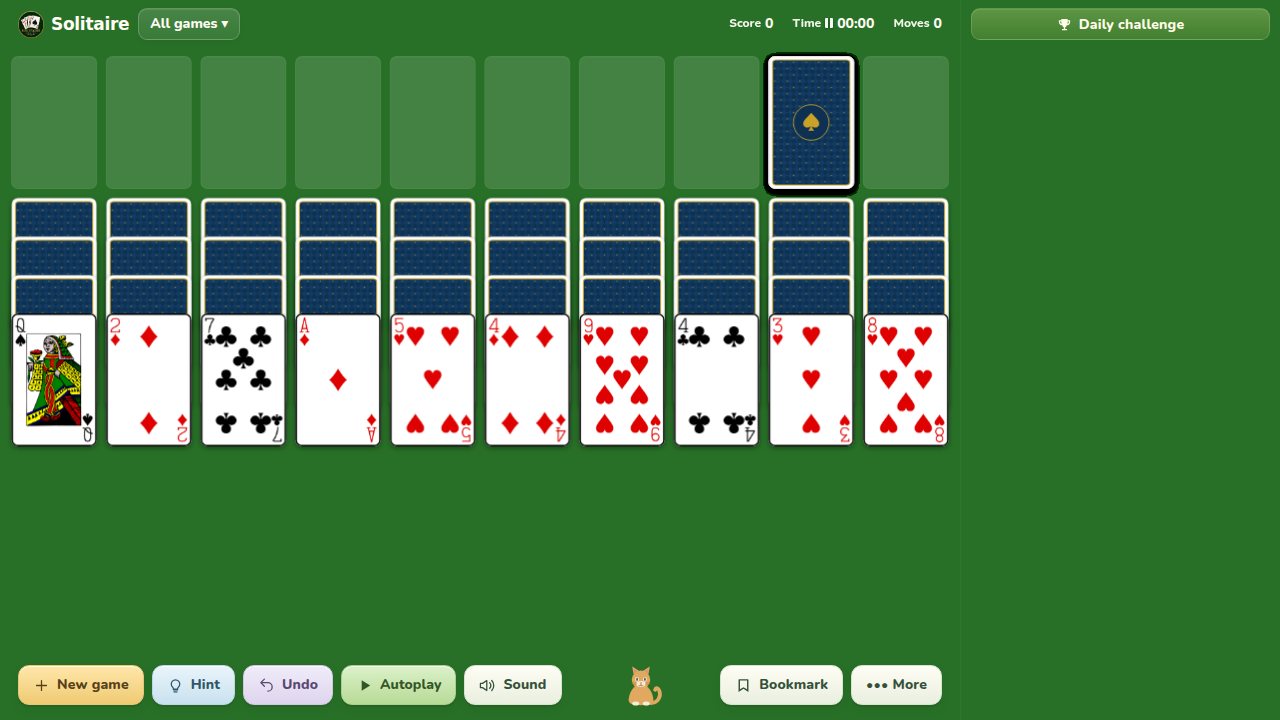 Solitaire
Ten columns hide a two-deck challenge. Alternate colors and make one stock pass count.
Rules · Screenshot · Strategy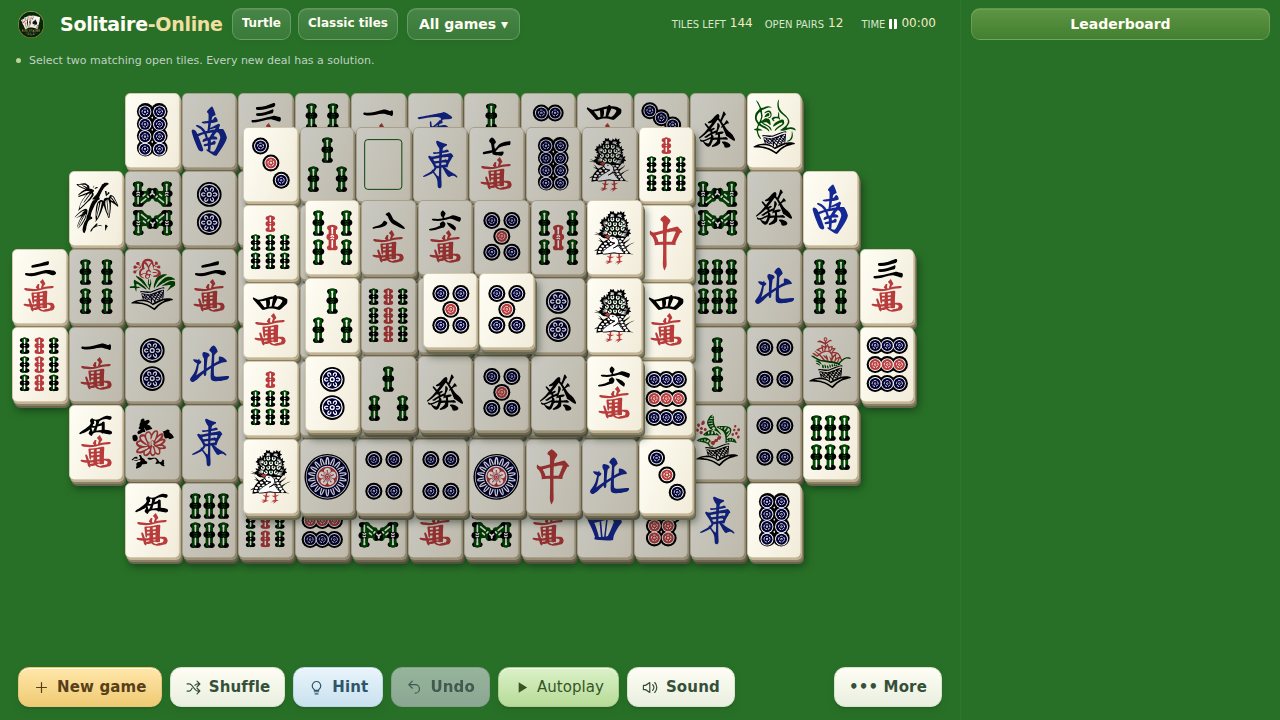 Puzzles
Match open tiles across Turtle, Courtyard and Pyramid layouts while protecting the pairs you need later.
Rules · Screenshot · Strategy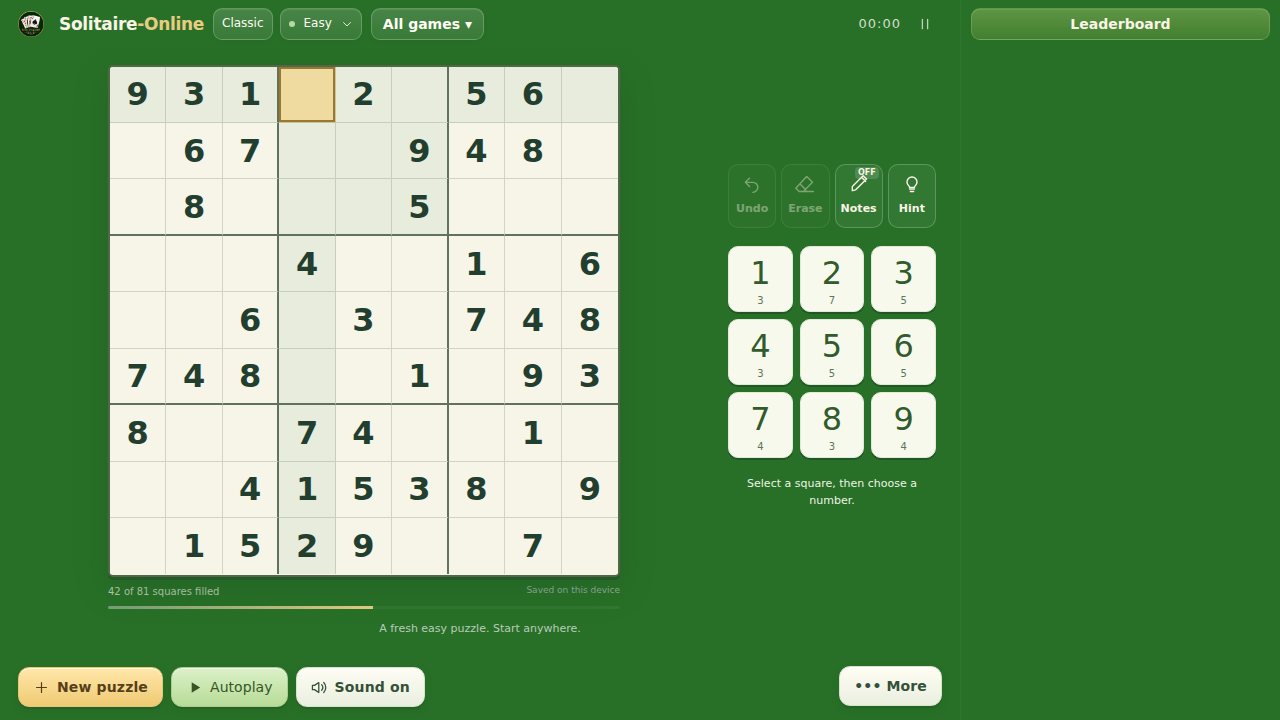 Puzzles
Learn the row, column and box rules, a reliable solving routine, pencil notes and Killer Sudoku cages.
Rules · Screenshot · Strategy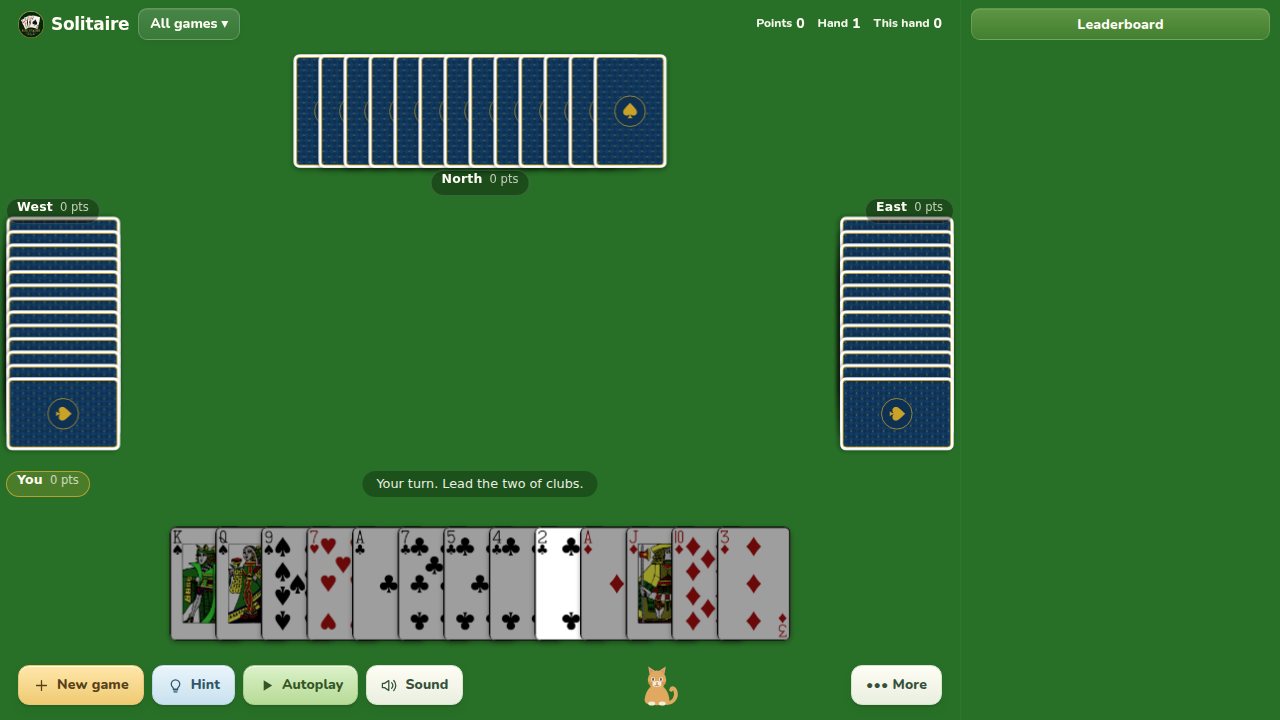 Computer card games
Hearts is the four-handed card game where the object is to score as little as possible, and this is the version you can play against the computer for free, straight in the browser. You take one seat, three computer opponents take the others, and they pass, duck and hunt the queen of spades the way real players do rather than throwing out whatever happens to be legal.
Rules · Screenshot · Strategy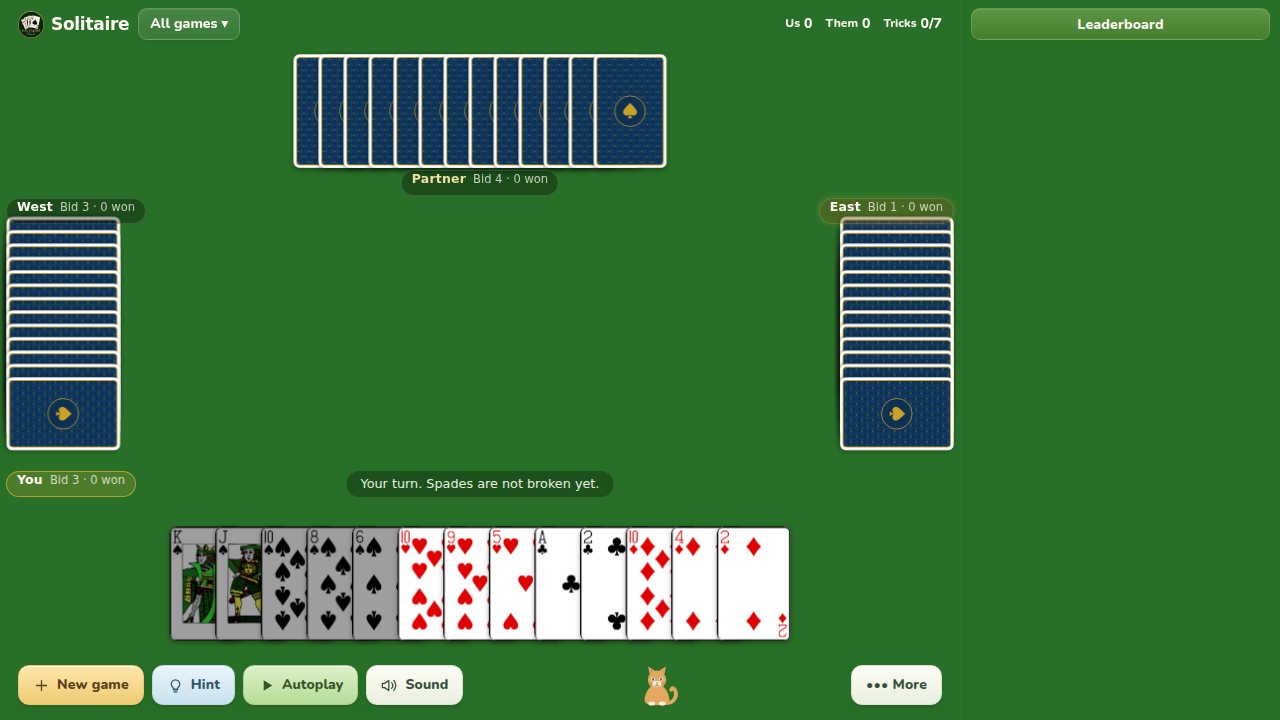 Computer card games
Spades is the partnership trick-taking game, and this is the free online version where you play against the computer. You sit opposite a computer partner, with two computer opponents to your left and right. Everybody bids the number of tricks they expect to win, spades are permanently trumps, and the side that makes its contract scores.
Rules · Screenshot · Strategy