 Solitaire
Forty Thieves Solitaire at a glance
Forty Thieves Solitaire, also searched as 40 Thieves Solitaire, is the connoisseur's game: two full decks, ten columns of four cards, the forty thieves themselves, and rules that give you nothing for free. You build down in suit, move only one card at a time, and get a single pass through the stock with no redeal.
Eight foundations must be built from Ace to King to win, and every card you bury in the tableau is a promise you will have to keep later. It is demanding, old-fashioned in the best way, and enormously satisfying when a deal finally comes out.
Play above, then use the Forty Thieves rules and strategy guide for a worked empty-column plan. For another reserve-heavy challenge, try Canfield Solitaire.
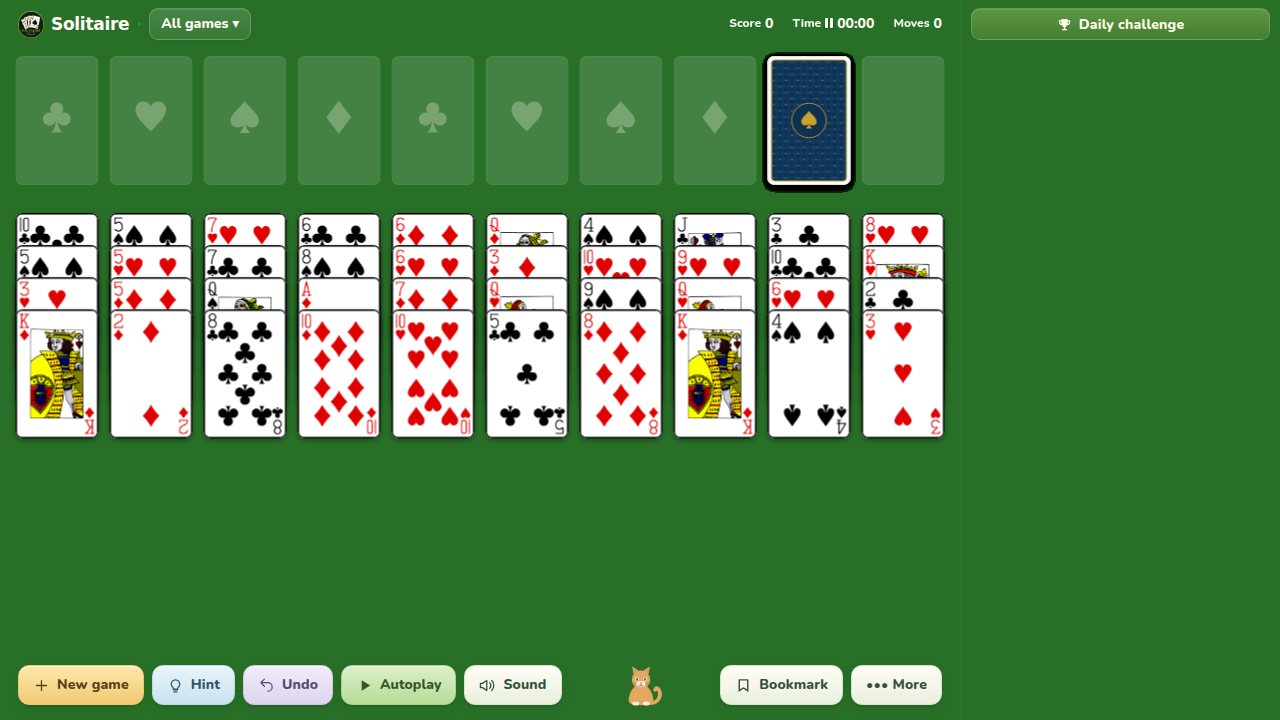
Rules and objective
- Build the eight foundations up from Ace to King in suit; all 104 cards home wins.
- In the tableau, build down in the same suit, one card at a time.
- Any single card may be placed on an empty column.
- Click the stock to deal one card to the waste. There is no redeal.
The table enforces legal moves and saves the current deal in this browser. Hints identify a move that is available now; they do not guarantee that the deal can still be won.
Strategy: how to play better
- Empty columns are the only way to relocate buried cards one at a time. Make one early and guard it.
- Be careful stacking same-suit cards in the tableau: a 9 on a 10 is safe, but a second 9 of that suit buried elsewhere may now be stranded.
- The stock has no second pass, so play every tableau move you can before each draw.
Frequently asked questions
Why can I only move one card at a time?
That is the defining rule of Forty Thieves: even a perfectly ordered same-suit run must be carried one card per trip, usually through an empty column. It is what makes the game hard.
Is there a redeal in Forty Thieves?
No. Once the stock is exhausted, the cards in the waste stay where they are. One pass is all you get.
How often can Forty Thieves be won?
Rarely. It is one of the tougher classic solitaires, and losing most deals is normal even for strong players. Empty-column management is what separates wins from losses.
How is Forty Thieves scored here?
Ten points for every card you send home and minus ten for every card you take back off a foundation, plus a time bonus at the end. The penalty is the useful part: it prices the retreat you will eventually need to make, and watching the score dip is usually the first sign you sent a mid-rank card home too early.
Are Forty Thieves and 40 Thieves Solitaire the same game?
Yes. Forty Thieves Solitaire and 40 Thieves Solitaire are two names for the same two-deck game with ten tableau columns, single-card moves and one pass through the stock.