 Solitaire
Canfield Solitaire at a glance
Canfield comes from an actual casino: in the 1890s, gamblers at Richard Canfield's Saratoga club bought a deck for $50 and won $5 back for every card they managed to play to the foundations. The house did famously well, which tells you what kind of game this is.
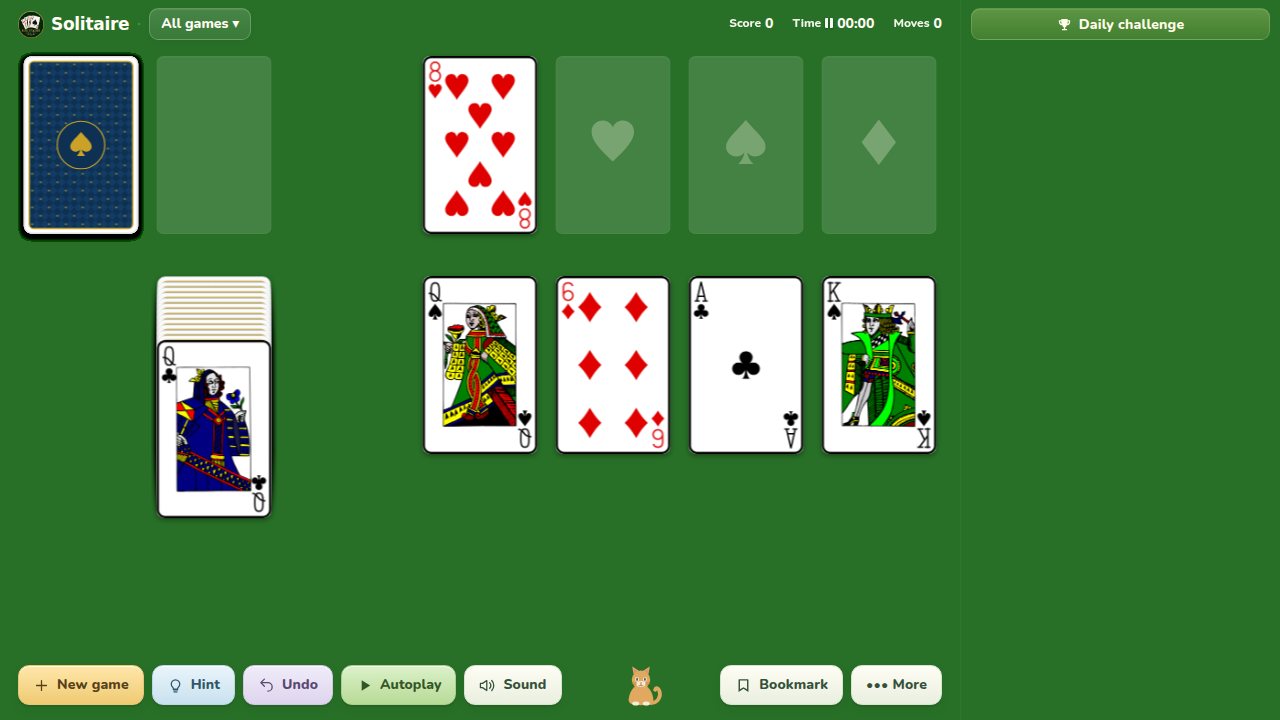
A dealt card fixes the starting rank for all four foundations, which build upwards in suit and wrap past the King. A thirteen-card reserve feeds the four tableau columns automatically as they empty, and the stock deals three at a time with unlimited redeals. Beating it feels like getting one over the house, because you are.
Play Canfield Solitaire online free above or read the complete Canfield rules and strategy guide. If you prefer a two-deck game with no redeal, compare Forty Thieves Solitaire.
Rules and objective
- The first card dealt to a foundation sets the base rank. All four foundations start there and build up in suit, wrapping from King back to Ace.
- The four tableau columns build down in alternating colours, also wrapping.
- Empty columns refill automatically from the thirteen-card reserve.
- The stock deals three cards at a time, with unlimited redeals.
- All 52 cards on the foundations wins.
The table enforces legal moves and saves the current deal in this browser. Hints identify a move that is available now; they do not guarantee that the deal can still be won.
Strategy: how to play better
- The reserve is your real opponent. Every chance to play a reserve card is worth taking.
- Remember the wrap: with a base of 7, the Queen sits "below" the King, which changes which cards are urgent.
- Use the unlimited redeals; playing even one card out of the waste changes which cards surface on later passes.
Frequently asked questions
Why do the foundations not start with Aces?
Canfield deals one card to a foundation at the start, and its rank becomes the base for all four. Each foundation climbs from that rank and wraps past the King. A base of 9 runs 9, 10, J, Q, K, A, 2 and on to 8.
What is the reserve in Canfield?
A face-down stack of thirteen cards dealt at the start. Its top card is always playable, and it automatically refills any tableau column that empties. Emptying the reserve is most of the battle.
Why is Canfield so hard to win?
It was designed as a casino game where the house profited when players fell short. Win rates are genuinely low, so consider anything above the occasional win a strong result.
Can I play Canfield Solitaire online for free?
Yes. Play Canfield Solitaire free in your browser with hints, unlimited undo and no download or account required.