 Solitaire
FreeCell at a glance
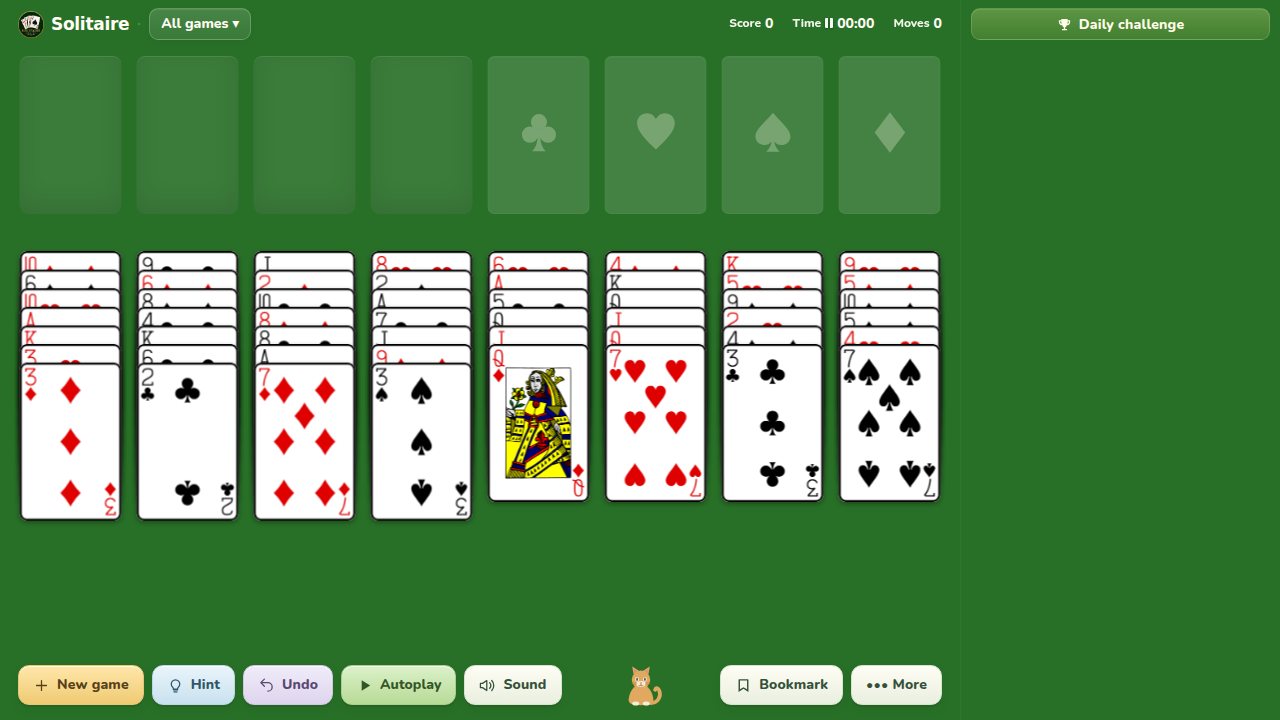
FreeCell is the solitaire with no secrets: all 52 cards are dealt face up from the very first moment, so nothing is left to luck. Four free cells, each a single-card parking space, give you just enough room to take a shuffled deck apart, and almost every deal can be won with careful play.
This version supports proper supermoves (moving whole runs at once, limited by your free cells and empty columns), safe auto-finish when the game is decided, and unlimited undo for exploring lines. If you lose at FreeCell, it almost always was winnable, which is exactly what makes it so addictive.
Learn how empty columns increase your move limit in our FreeCell rules and strategy guide. Our solitaire win-rate guide explains the difference between solver results and player wins. Prefer uncovering hidden cards? Try Spider Solitaire with 1, 2 or 4 suits.
Rules and objective
- Build the four foundations up from Ace to King in suit; fill them all to win.
- In the eight columns, build downwards in alternating colours.
- Any single card may be parked in an empty free cell and brought back later.
- Any card or run may be placed on an empty column.
- The number of cards you can move at once equals (1 + empty cells) × 2empty columns.
The table enforces legal moves and saves the current deal in this browser. Hints identify a move that is available now; they do not guarantee that the deal can still be won.
Strategy: how to play better
- Plan several moves ahead before touching anything. You can see everything, so use it.
- Keep at least one free cell open; a full set of cells is how most games are lost.
- Empty a short column early; each empty column doubles your mobility.
Frequently asked questions
Why can I only move a few cards at once?
FreeCell moves big runs by shuttling single cards through free cells and empty columns, so the limit is one plus your empty cells, doubled for each empty column. Free up cells or clear a column to move bigger runs.
Is every FreeCell deal winnable?
Very nearly. Random deals are solvable in the overwhelming majority of cases. Of Microsoft’s famous 32,000 numbered deals, only one is proven impossible.
What is the safe auto-finish?
The auto-complete button appears the moment every column is in descending order, whatever the suits, because from that point no card can ever block another and the deal is decided. It is worth watching for: the button is the game telling you that you have already won, often a dozen moves before it looks obvious on the board.
How is FreeCell scored here?
Each card you send to a foundation is worth 10 points and each one you pull back off costs 10, so the score tracks real progress rather than activity. Finishing quickly adds a substantial time bonus on top, which is what separates a competent win from a fast one.