 Solitaire
How to Play FreeCell: The Solitaire You Can Almost Always Win
FreeCell is the solitaire purists point to when someone calls the genre mindless. Every card is visible from the first second, there is no stock and no shuffle to blame. If you lose, you were outplayed by your own planning.
Watch the video guide
The setup
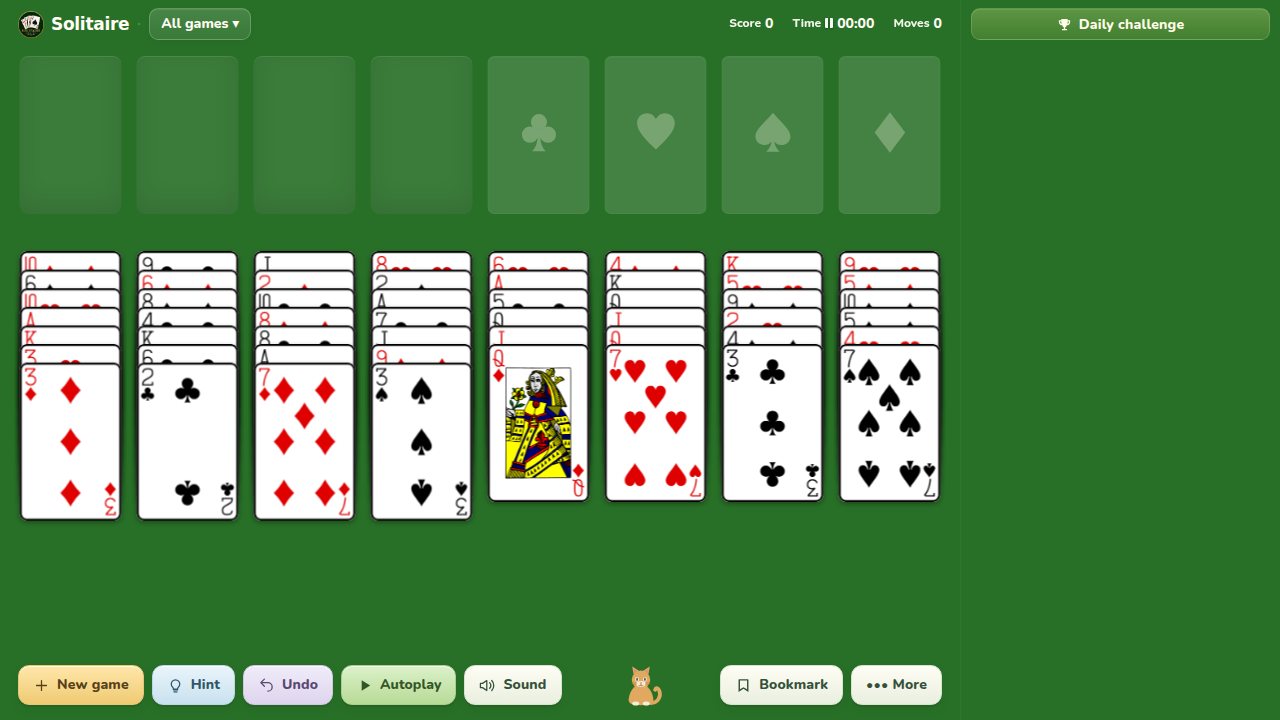
All 52 cards are dealt face up across eight columns: seven cards in the first four columns, six in the rest. Nothing is hidden. Four foundations wait to be built from Ace to King in suit, exactly as in Klondike, and four free cells sit alongside them.
In the tableau you build down in alternating colours, the same ladder as Klondike: a red 7 on a black 8, a black 6 on that red 7.
What the free cells do
Each free cell holds exactly one card. That is the entire mechanic, and it is what turns a shuffled deck into a solvable puzzle. A cell lets you lift a card out of the way, do something underneath it, and put it back. This is the sliding-tile-puzzle move that Klondike simply does not have.
The catch is that a card in a cell is inert. It blocks nothing and helps nothing while it sits there, and it costs you a slot. Four cards parked in four cells means you can no longer move more than one card at a time.
The supermove formula
Strictly speaking, FreeCell only ever moves one card at a time. When the game slides five cards at once, it is performing a sequence of single moves through your free cells and empty columns automatically. That is why the limit is arithmetic rather than arbitrary:
(1 + empty free cells) × 2(empty columns)
Moving into an empty column does not count that column, because the cards are going there.
| Free cells | Empty columns | Cards you can move |
|---|---|---|
| 0 | 0 | 1 |
| 2 | 0 | 3 |
| 4 | 0 | 5 |
| 4 | 1 | 10 |
| 4 | 2 | 20 |
Read that table once and FreeCell strategy becomes obvious: empty columns are worth roughly twice what a free cell is worth, and everything you do should protect both.
Why almost every deal is winnable
Because nothing is hidden, FreeCell has no element of unknowable luck. It turns out that a shuffled deck plus four cells is nearly always enough freedom to sort it out.
The best-known evidence is Microsoft’s set of 32,000 numbered deals that shipped with Windows. Enthusiasts worked through all of them, and exactly one has been proven impossible: game #11982. That single deal has become the most famous hand in solitaire.
When you lose at FreeCell, you almost certainly lost a winnable position. That is a harder truth than Klondike offers, and it is why the game rewards planning before you touch a card.
Five strategy rules
1. Plan the whole line before your first move
Everything is visible, so unlike other solitaires you can actually read several moves ahead. Trace the sequence out before committing.
2. Free your Aces and twos early
They are pure gain. Dig them out and send them home as soon as it is practical, because they unlock the foundations that everything else drains into.
3. Keep at least one cell empty
Filling all four cells is how most losses begin. Each occupied cell halves your effective mobility, and a board with zero free cells and no empty column is usually finished.
4. Empty a column as early as you can
Empty columns are the most powerful resource in the game: they double your supermove size and accept any card. Target the shortest column and clear it.
5. Do not rush cards to the foundations
The same caution as Klondike, for the same reason: a 7 on a foundation cannot hold a 6 for you. FreeCell’s auto-finish will sweep everything up safely once the board is trivially ordered, so there is no hurry.
Frequently asked questions
How many cards can I move at once in FreeCell?
Multiply one plus the number of empty free cells by two raised to the number of empty columns. With all four cells free and no empty columns you can move five cards; with four cells and two empty columns, twenty.
Is every FreeCell game winnable?
Almost. Of Microsoft’s famous 32,000 numbered deals, exactly one, game #11982, has been proven unsolvable. Across randomly generated deals the unsolvable share is a tiny fraction of one percent.
What goes in an empty FreeCell column?
Any card or any movable sequence. There is no King restriction, which makes empty columns extremely powerful. Each one roughly doubles how many cards you can relocate at a time.
Is FreeCell harder than Klondike?
It is harder to play well but far easier to win. Klondike hides most of its cards and hands you unwinnable deals regularly; FreeCell hides nothing, so a loss is usually a planning error rather than bad luck.