 Solitaire
Spider Solitaire at a glance
Spider solitaire deals 104 cards from two full decks across ten columns, and asks you to untangle them into eight complete King-to-Ace runs. There are no foundations to build and no waste pile to cycle: everything happens on the board, which is why Spider is often called the thinking player's solitaire.
Choose your difficulty before you deal: 1 suit to learn the flow, 2 suits for a real game, or the full 4-suit spread if you want the cards to fight back. Unlimited undo and hints are free, and your game saves automatically.
New to the game? Our Spider Solitaire rules and strategy guide explains how to build movable runs. Ready for the balanced version? Play Spider Solitaire 2 Suits. For the full challenge, play Spider Solitaire 4 Suits. For a different challenge with every card visible, try FreeCell Solitaire.
Choose 1 Suit, 2 Suits or 4 Suits
Choose the Spider Solitaire difficulty that suits you. Start with 1 Suit to learn the rules, move to 2 Suits for a balanced challenge, or play 4 Suits for the full classic Spider experience.
| Mode | Difficulty | Best for |
|---|---|---|
| 1 Suit | Easy | Beginners learning how Spider works |
| 2 Suits | Medium | Regular players who want more strategy |
| 4 Suits | Hard | Experienced players seeking the classic challenge |
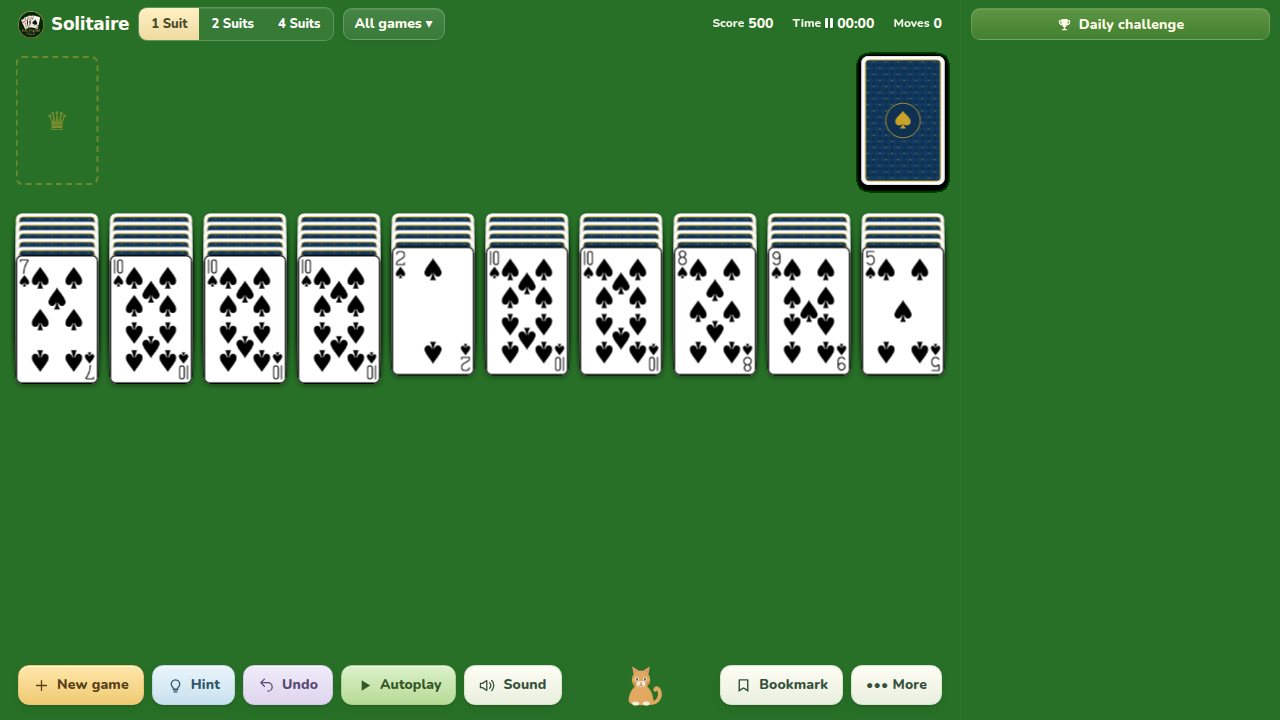
Rules and objective
- Build cards downwards on any card one rank higher. Suit does not matter for placing.
- Only a same-suit descending run can be picked up and moved as a group.
- Complete a King-to-Ace run in one suit and it lifts off the board automatically.
- Any card or movable run may go on an empty column.
- Click the stock to deal a new card onto every column, but only when no column is empty.
- Clear all eight runs to win.
The table enforces legal moves and saves the current deal in this browser. Hints identify a move that is available now; they do not guarantee that the deal can still be won.
Strategy: how to play better
- Build in suit whenever you have the choice. Mixed-suit piles freeze and must be untangled later.
- Tidy the board before each deal; ten new cards land on top of whatever you leave.
- Keep an empty column open as a workspace whenever you can afford to.
Frequently asked questions
Why can I not deal new cards from the stock?
Spider blocks the deal while any column is empty. Place at least one card on every empty column, then click the stock again.
Which Spider difficulty should I play?
Start with 1 suit until you win regularly, then move up to 2 suits, where most players settle. Four suits is a serious challenge where many deals cannot be won at all.
Why will my sequence not move?
Only descending runs in a single suit move as a group. A sequence that mixes suits is legal to build but must be taken apart one card at a time.
How is Spider Solitaire scored here?
Every completed King-to-Ace run you clear off the board is worth 100 points, every move you make costs 1, and finishing adds whatever is left of a 1,000-point time bonus. That scoring is the quickest honest measure of whether you are improving: a tidy 150-move win beats a lucky 350-move one, and the counter in the header tells you which kind of game you just played.
Can I play Spider Solitaire online without downloading?
Yes. Spider Solitaire runs directly in your browser and is completely free to play. Choose 1, 2 or 4 suits and start immediately without downloading an app or creating an account.