 Solitaire
How to Play Canfield Solitaire: Rules, the Reserve and Wrapping Foundations
Canfield was designed to make money for a casino, and it shows. A thirteen-card reserve sits between you and the board, the foundations start at whatever rank the deal chooses, and the whole thing wraps past the King as though the deck were a circle.
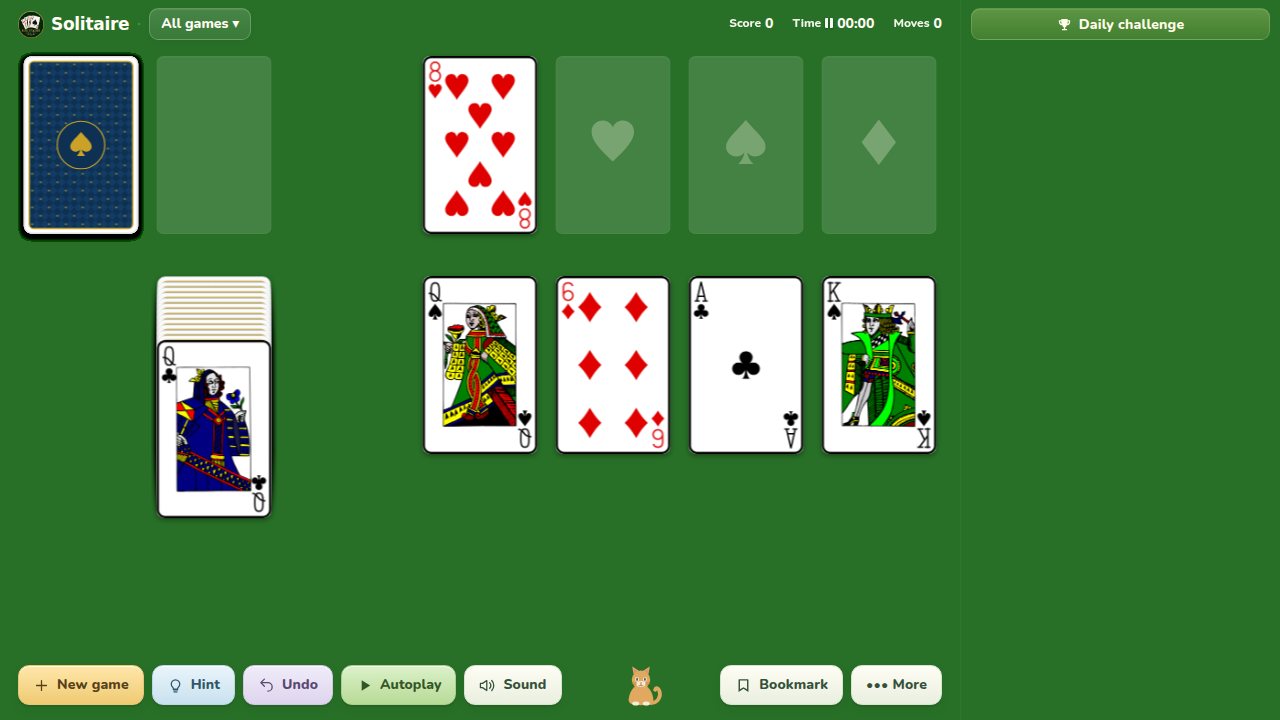
Watch the video guide
The casino it came from
In the 1890s Richard Canfield ran a gambling house in Saratoga Springs where you could buy a deck of cards for fifty dollars and be paid five dollars for every card you managed to get onto a foundation. Fifty-two cards home would have paid $260. The house did extremely well, which tells you most of what you need to know about the odds before you deal.
The board, explained
| Area | What it holds |
|---|---|
| Reserve | Thirteen cards, face down except the top one. Always playable from the top, and it automatically refills any empty tableau column. |
| Tableau | Four columns, one card each to start. Builds down in alternating colours, and it wraps. |
| Foundations | Four spaces. One card is dealt here at the start and sets the base rank for all four. |
| Stock and waste | The remaining 34 cards, dealt three at a time, with unlimited redeals. |
The base rank and wrapping
The single card dealt to the first foundation decides the game. Whatever rank it is becomes the starting rank for all four foundations, and each one climbs from there, past the King, round to the Ace and onward.
| Base card | That foundation runs |
|---|---|
| Ace | A, 2, 3 ... K. The familiar order. |
| 7 | 7, 8, 9, 10, J, Q, K, A, 2, 3, 4, 5, 6 |
| Queen | Q, K, A, 2, 3 ... J |
The tableau wraps too, in the other direction: a King may be placed on an Ace of the opposite colour, so a descending run can pass straight through the turn of the deck.
With a base of 7, the Queen is not a high card any more. It is only five steps from home, while the 6 is twelve steps away and effectively the last card of the game. Work out the new order before you decide which cards to keep.
The four legal moves
- Build the foundations up in suit from the base rank, wrapping past the King.
- Build the tableau down in alternating colours, also wrapping. Ordered runs move as a group.
- Play the top card of the reserve to a foundation or onto a tableau column. This is always available and almost always worth doing.
- Deal three cards from the stock to the waste and play the top one. Cycle as often as you like.
The reserve is the real opponent
Thirteen of the fifty-two cards are locked in a single pile that only opens one card at a time. Until the reserve is empty, a quarter of the deck is unavailable to you, and the cards you need are as likely to be in there as anywhere else.
So the priority order in Canfield is unusual: play from the reserve whenever it is legal, even when a different move looks more productive. A reserve card played is a card unlocked. A tableau move that does not touch the reserve has, at best, kept things tidy.
The one exception is the automatic refill. Empty a tableau column and the reserve fills it for you, which is a free reserve card, so making a column empty is worth as much as playing one directly.
Four mistakes that waste a deal
Filling an empty column yourself
If you place a card in an empty column, the reserve does not get to. Let the refill happen unless you have a concrete reason not to.
Playing as though Aces matter
Unless the base card is an Ace, an Ace is just a middling card that happens to sit after the King. Ranking cards by their distance from the base is the mental switch this game demands.
Not using the redeals
They are unlimited. Playing even one card out of the waste changes which cards surface on the next pass, so a stock that looked dead can open up after a single tableau move.
Treating a lost deal as bad play
Canfield was engineered to be lost. Getting a good share of the deck home is a respectable outcome, and it is exactly what the original players were paid for.
Frequently asked questions
Why do the foundations not start with Aces in Canfield?
One card is dealt to a foundation at the start and its rank becomes the base for all four. If that card is a 9, every foundation runs 9, 10, Jack, Queen, King, Ace, 2 and on up to 8. The wrap past the King is what lets a foundation started at any rank still hold thirteen cards.
What is the reserve in Canfield?
A stack of thirteen cards dealt face down at the start with only the top one visible. Its top card is always playable, and it refills any tableau column that empties, automatically. Emptying it is most of the game.
Can I move a group of cards in Canfield?
Yes. An ordered run of alternating colours moves as one piece, and because the tableau wraps as well, a run may pass from an Ace down to a King and keep going.
How many redeals do I get?
Unlimited. The stock deals three cards at a time and you may cycle it as often as you like, so a Canfield deal is never lost to running out of passes. It is lost to positions that genuinely cannot be untangled.
Why is Canfield so hard to win?
Because it was built that way. It was a casino game where the house profited when players fell short, and the reserve exists specifically to hold thirteen cards hostage. Win rates are low, so treat any win as a good result.