 Solitaire
How to Play Forty Thieves: Rules, Strategy and Empty Columns
Forty Thieves gives you 104 cards, eight foundations to fill and almost no help. You move one card at a time, you build only in suit, and you get a single pass through the stock. It is the connoisseur’s solitaire, and it rewards planning further ahead than any other game on this site.
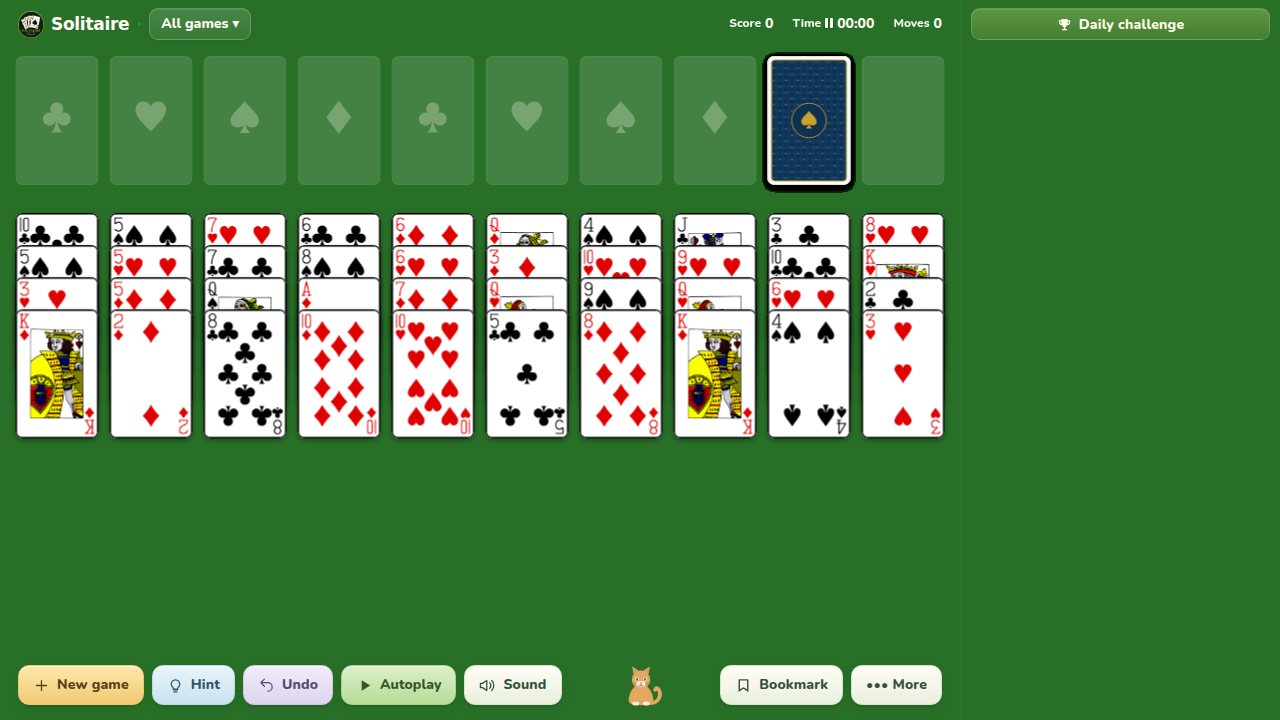
The board, explained
Forty Thieves is a two-deck game, so the board is wider and the arithmetic is bigger than anything in the single-deck family. There are 104 cards, and they start in three places.
| Area | Where it is | What it holds |
|---|---|---|
| Tableau | Ten columns across the table | Forty cards, four to a column, every one of them face up. These are the forty thieves the game is named after. |
| Stock | Face-down pile at the top | The remaining 64 cards. Click to turn one card at a time onto the waste. |
| Waste | Beside the stock | Cards you have turned over. Only the top one is playable. |
| Foundations | Eight spaces along the top | Empty at the start. Two per suit, because there are two decks. |
Nothing is face down in the tableau. There are no hidden cards to uncover and no flips to earn. Every difficulty in Forty Thieves comes from the movement rules and the stock, not from missing information.
How you win
Fill all eight foundations from Ace to King in suit. That is 104 cards home, two complete runs in each of the four suits.
The four legal moves
1. Build down the tableau, in suit
A card lands on a card one rank higher of the same suit. The 6 of clubs goes on the 7 of clubs and nowhere else, although with two decks there are two 7s of clubs in play, so a card has two possible parents rather than Russian Solitaire’s one.
2. Move exactly one card
There are no group moves in Forty Thieves. Not for ordered runs, not for anything. A four-card same-suit sequence takes four separate moves and four separate places to put things, which is why the next section matters more than any other part of this guide.
3. Play any single card to an empty column
Unlike Klondike, an empty column here accepts anything at all. A 2, a King, a card from the waste, whatever helps.
4. Turn one card from the stock
One click, one card, onto the waste. The top of the waste is always live and everything under it is frozen until you play the top away.
One card at a time, and no redeal. Between them, those two rules mean every tableau move you fail to spot before a draw is a move you may never get back.
Empty columns are the whole game
Because you can only carry one card per move, relocating an ordered run means parking the cards somewhere in between. Empty columns are that somewhere, and the number you hold sets a hard ceiling on what you can reorganise.
| Empty columns | What you can actually relocate |
|---|---|
| 0 | Single exposed cards onto legal same-suit parents. Nothing else. |
| 1 | A two-card run: park the top card, move the bottom one, bring the parked card back. |
| 2 | A three-card run, and enough room to unpick a badly ordered pile. |
| 3 or more | Most positions become tractable. This is what a winning board looks like. |
The practical consequence is that an empty column is worth far more than a tidy build. If you can choose between placing a card neatly onto its same-suit parent and clearing the last card out of a short column, clear the column almost every time.
Never fill an empty column without a reason you can state. Parking a card there to get it out of the way costs you the workspace that would have unpicked a whole pile ten moves later. If the card has a legal same-suit parent anywhere on the board, put it there instead.
One pass, and what that really costs
The stock deals one card at a time, so you will see all 64 of them, but you will see each one exactly once. When a card lands on the waste you have a single opportunity to place it. Draw again and it is buried.
Buried is not quite gone. The waste is a stack you unpick from the top, so a card two down becomes available again once you find homes for the two cards sitting on it. But you cannot deal fresh cards to help you do that, which means the deeper a useful card is, the less realistic recovering it becomes.
All of which leads to the single most valuable habit in the game: exhaust the tableau before every draw. Tableau moves are free and repeatable. Draws are a resource with a hard limit of 64, and each one buries whatever you did not use.
A plan for your first deal
- Send every Ace and 2 up immediately. With eight foundations there is no reason to hold low cards back, and each one you clear shortens a column.
- Look for the shortest route to an empty column. Find the column whose four cards have the most homes elsewhere and work on emptying it before you do anything decorative.
- Check the twin before every build. Two decks means two of every card. Placing the 9 of hearts on a 10 of hearts is only good if the other 9 of hearts has somewhere to go too.
- Play out the whole board, then draw. Every legal tableau move first. The stock is the last resort, not the default click.
- Take waste cards the moment they help. A card that fits now and is buried later is a card you have lost.
- Undo freely. Forty Thieves punishes small errors twenty moves after you make them, and stepping back to the branch point is the only way to learn which move was the mistake.
Five mistakes that end a deal early
Filling an empty column with a card that had somewhere else to go
The most common losing move in the game, and it never feels like a mistake at the time. A column is a tool. Spending it to tidy one card away is like selling a ladder to store a hat.
Building deep same-suit piles in the tableau
A long run looks like progress, but with single-card moves it is effectively a locked box. Everything above the card you want has to come off one at a time, and the cards you buried are exactly the ones you will need for the second foundation of that suit.
Clicking the stock out of habit
There are 64 draws in the entire game and no second pass. Reaching the end of the stock with the board still tangled is how most deals are lost.
Forgetting the second deck
Every card exists twice, including both Aces of a suit and both Kings. Plan for the pair, not the card in front of you.
Racing the foundations
Sending cards home fast feels productive, but a 7 on a foundation cannot host the 6 that is stuck under three other cards. With eight foundations to feed, mid-rank cards are often more useful on the board than off it.
Frequently asked questions
Why can I only move one card at a time in Forty Thieves?
It is the defining rule of the game. Even a perfectly ordered same-suit run has to be carried one card per trip, which means you need somewhere to put the cards in between. That somewhere is an empty column, and the number of empty columns you hold is effectively the size of run you can relocate.
Is there a redeal in Forty Thieves?
No. You get one pass through the 64-card stock, one card at a time, and when it is empty it stays empty. Everything you want from the stock has to be taken on the way past or dug back out of the waste.
What can go on an empty column in Forty Thieves?
Any single card, which is a much more generous rule than Klondike’s King-only restriction. That generosity is the point: an empty column is a workspace, and using it well is the difference between a won deal and a stuck one.
Does it matter that Forty Thieves uses two decks?
Enormously. There are two of every card, so building the 9 of hearts onto the 10 of hearts quietly strands the other 9 of hearts, which now has no home until that pile comes apart. Before you make a same-suit build, ask where the twin is.
How often can Forty Thieves be won?
Not often. It is among the least winnable of the classic solitaires, and losing most deals is normal even for experienced players. Win rates rise sharply with empty-column discipline and with playing every tableau move before each draw.