 Solitaire
Types of Solitaire: Which Game Should You Play?
Solitaire is a family of games, not a single set of rules. Some ask you to uncover hidden cards, some let you plan with the whole deck visible, and others replace long sequences with quick matching decisions. Here is how nine familiar versions differ, and where to start.
Choose by the kind of game you want
- A familiar starting point: Klondike Draw 1 teaches alternating colors, hidden cards and foundations.
- A puzzle you can plan from the start: FreeCell shows every card and gives you four holding cells.
- A longer sorting challenge: Spider uses 104 cards and rewards keeping runs movable.
- Quick matching decisions: try Pyramid for pairs that total 13, or TriPeaks for cards one rank apart.
- A new twist on moving columns: Yukon lets you move groups that are not already in sequence.
These comparisons describe the versions playable on this site. Details such as stock passes, empty-column rules and whether Ace and King connect can vary between implementations.
Nine types of solitaire at a glance
| Game | Cards | Goal | What makes it different |
|---|---|---|---|
| Klondike | 52 | Four Ace-to-King foundations | Uncover hidden cards; draw from a stock. |
| FreeCell | 52 | Four Ace-to-King foundations | All cards are visible; four cells provide temporary space. |
| Spider | 104 | Eight same-suit King-to-Ace runs | Mixed suits can be stacked, but cannot move together. |
| Pyramid | 52 | Clear the pyramid | Pair exposed cards totaling 13; remove Kings alone. |
| TriPeaks | 52 | Clear three overlapping peaks | Remove cards one rank above or below the waste. |
| Golf | 52 | Clear seven columns | Read the visible columns and build a chain onto the waste. |
| Yukon | 52 | Four Ace-to-King foundations | Move a face-up card with everything below it, even a mixed group. |
| Russian Solitaire | 52 | Four Ace-to-King foundations | Yukon-style group moves, with same-suit destinations. |
| Forty Thieves | 104 | Eight Ace-to-King foundations | Move one card at a time and build columns in suit. |
Klondike, FreeCell and Spider: three ways to build
Klondike: uncover the hidden cards
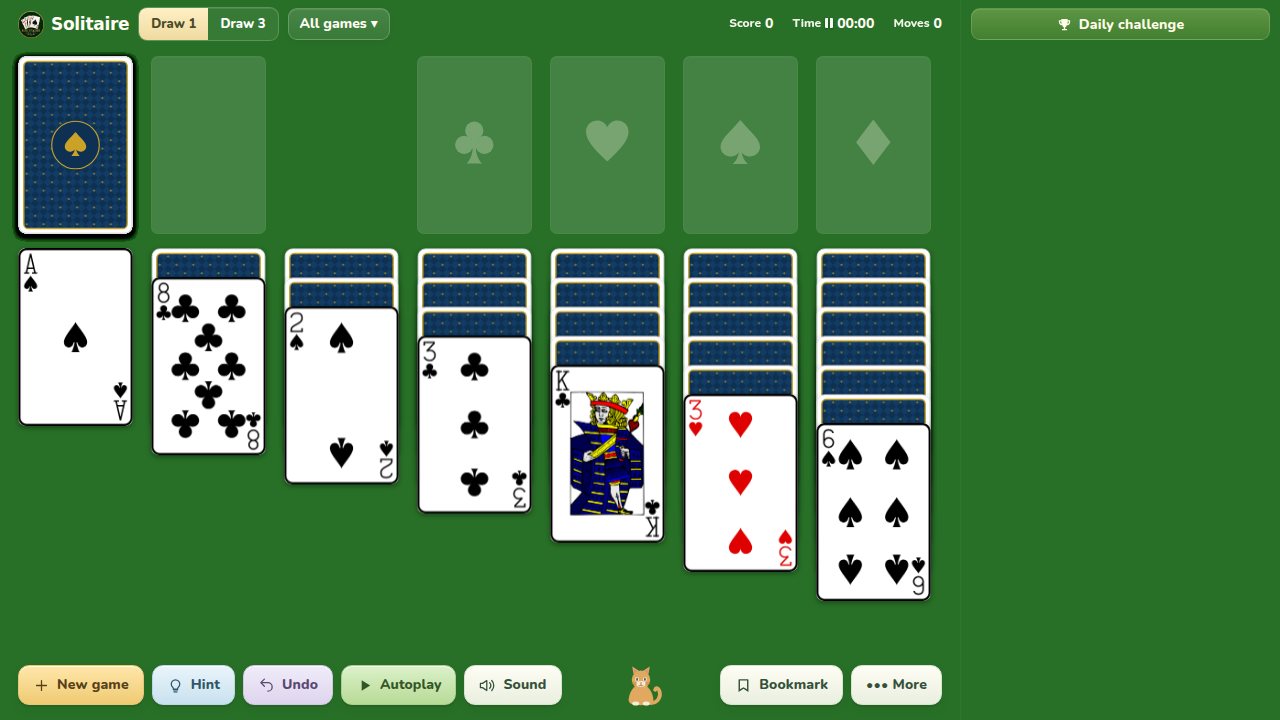
Klondike begins with seven columns containing one through seven cards. Only the bottom card of each column is face up. You build down in alternating colors, such as a black 8 on a red 9, and send cards to same-suit foundations from Ace upward. Empty columns take Kings.
The stock supplies cards that were not dealt into the columns. Draw 1 makes one new card available at a time; Draw 3 exposes cards in groups of three, with only the top card playable. Choose Klondike if you enjoy balancing what you can see against what the next turn might reveal. Start with the Klondike rules guide.
FreeCell: manage space with the whole deck visible
FreeCell deals all 52 cards face up into eight columns. There is no stock. Four free cells can each hold one card while you rearrange the columns. Like Klondike, the columns build down in alternating colors and the foundations build up in suit.
A visible card is not necessarily available: other cards may trap it. The number of cards you can transfer as a sequence depends on the empty cells and columns available to carry out the move. Try FreeCell if you prefer planning over discovering hidden cards, and read how free cells and sequence moves work before filling all four cells.
Spider: keep your sequences movable
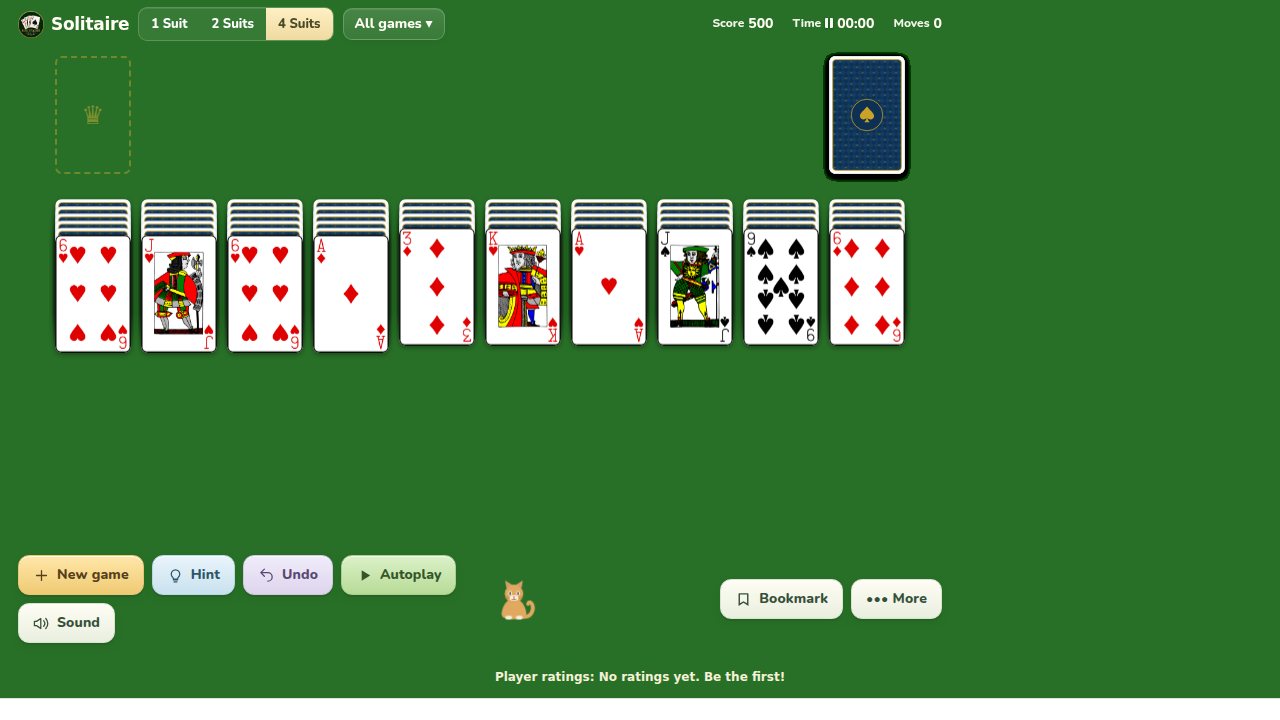
Spider has ten columns and two decks. You can place any 8 on any 9, but a group moves together only when it is descending in the same suit. Completed King-to-Ace runs leave the board automatically. The stock deals one new card onto every column at once, so each deal can interrupt several promising sequences.
The suit count changes the challenge without changing the goal:
- 1 suit: every descending run matches suit. Use this to learn the stock and empty-column rules.
- 2 suits: hearts and spades introduce mixed runs that you must separate.
- 4 suits: all four suits make matching runs harder to assemble. Choose it when you enjoy planning several rearrangements ahead.
Pyramid, TriPeaks and Golf: clear the layout
Pyramid: find pairs totaling 13
Pyramid replaces suit building with arithmetic. Remove two exposed cards whose values total 13: Ace and Queen, 2 and Jack, 3 and 10, and so on. A King is worth 13 and can be removed alone. Cards covered by either of the two cards below them are not yet free.
The useful question is which pair opens the next pair. Removing a convenient pair may leave its matching values trapped higher in the pyramid. Choose Pyramid if you like a clear matching rule with a visible dependency puzzle. The Pyramid guide explains the stock and exposed-card rules.
TriPeaks: choose which peak to open
TriPeaks arranges 28 cards into three overlapping peaks. Play an exposed card one rank above or below the waste card, ignoring suit. If the waste shows a 7, either a 6 or an 8 can continue the chain. Drawing from the stock gives you a new waste card when you need one.
When two cards fit, compare what each would uncover and whether the next rank can extend your chain. Try TriPeaks if you enjoy opening paths through a covered layout. See the TriPeaks rules for this version's rank connections.
Golf: plan a chain through visible columns
Golf uses a similar one-rank-up-or-down rule, but starts with 35 face-up cards in seven columns. Only the bottom card of each column is playable. You can see possible chains further up the columns and decide which order might release them. On this site, King and Ace do not wrap around.
Choose Golf when you want a simple movement rule with more information visible from the start. You are clearing the tableau, not building four foundations. Read the Golf guide for a worked explanation of legal moves.
Yukon, Russian Solitaire and Forty Thieves: change the movement rule
Yukon: move a group before it is sorted
Yukon resembles Klondike, but all cards are dealt into the tableau and there is no stock. You may select a face-up card and move it with every card below it, even if that group is not in order. The selected card must land on a card one rank higher and of the opposite color. Empty columns take Kings.
For example, a red 6 can move onto a black 7 even when an unrelated Queen sits below the 6; the Queen travels with it. This freedom helps you uncover buried cards but can also create bulky groups. Try Yukon if you like Klondike and want more control over the columns.
Russian Solitaire: Yukon with same-suit building
Russian Solitaire keeps Yukon's ability to move an unsorted group, but the selected card must land on the next-higher card of the same suit. The 6 of hearts needs the 7 of hearts, rather than any black 7. That tighter rule makes finding and freeing the right destination especially important.
Choose Russian Solitaire after trying Yukon. It is different from Russian Bank, a separate two-player card game. The Russian Solitaire guide covers group moves in more detail.
Forty Thieves: two decks, one card at a time
Forty Thieves deals 40 face-up cards into ten columns and keeps the rest of its two decks in a stock. Columns build down in suit, and you move one card at a time. Eight foundations build from Ace to King. The version here allows one pass through the stock.
Unlike Spider, finishing a descending run does not automatically remove it. You must feed the foundations upward, so an empty column is valuable temporary storage. Try Forty Thieves when you want to plan around strict movement limits, and check the Forty Thieves rules before committing a useful empty column.
What to try next
If you enjoy Klondike's building rules but dislike hidden information, try FreeCell. If you enjoy sorting long runs, move from one-suit Spider to two suits, then four. If you prefer short chains over column rearrangement, compare Golf with TriPeaks. For a twist on familiar tableau play, move from Klondike to Yukon, then Russian Solitaire.
There is no single best type for everyone. Play a few deals, notice which decisions you enjoy, and use the full games catalog when you want another variation. Changing games can be more useful than increasing difficulty in a game whose rules you do not enjoy.
Frequently asked questions
What are the main types of solitaire?
Common card solitaire games include Klondike, Spider, FreeCell, Pyramid, TriPeaks, Golf, Yukon, Russian Solitaire and Forty Thieves. They differ in how cards move and whether the goal is to build foundations, complete runs or clear a layout.
Which solitaire should a beginner try?
Klondike Draw 1 is a useful introduction to columns and foundations. For fewer movement rules, try TriPeaks or Golf. For Spider, start with one suit before trying two or four. Simple rules do not mean every deal is winnable.
What is the difference between Klondike and FreeCell?
Klondike has hidden cards and a stock to draw from. FreeCell starts with all 52 cards face up and no stock, and provides four temporary holding cells. Both build alternating colors in the columns and same-suit foundations from Ace to King.
Are Spider 1 Suit, 2 Suits and 4 Suits different games?
They share the same 104-card layout and goal of completing eight King-to-Ace runs. The number of suits changes. Since only a descending group in one suit can move together, adding suits creates more sequences that must be separated.
Does solitaire always use one deck?
No. Klondike, FreeCell, Pyramid, TriPeaks, Golf, Yukon and Russian Solitaire use one 52-card deck in the versions described here. Spider and Forty Thieves use two decks, or 104 cards.