 Solitaire
Triangle Solitaire at a glance
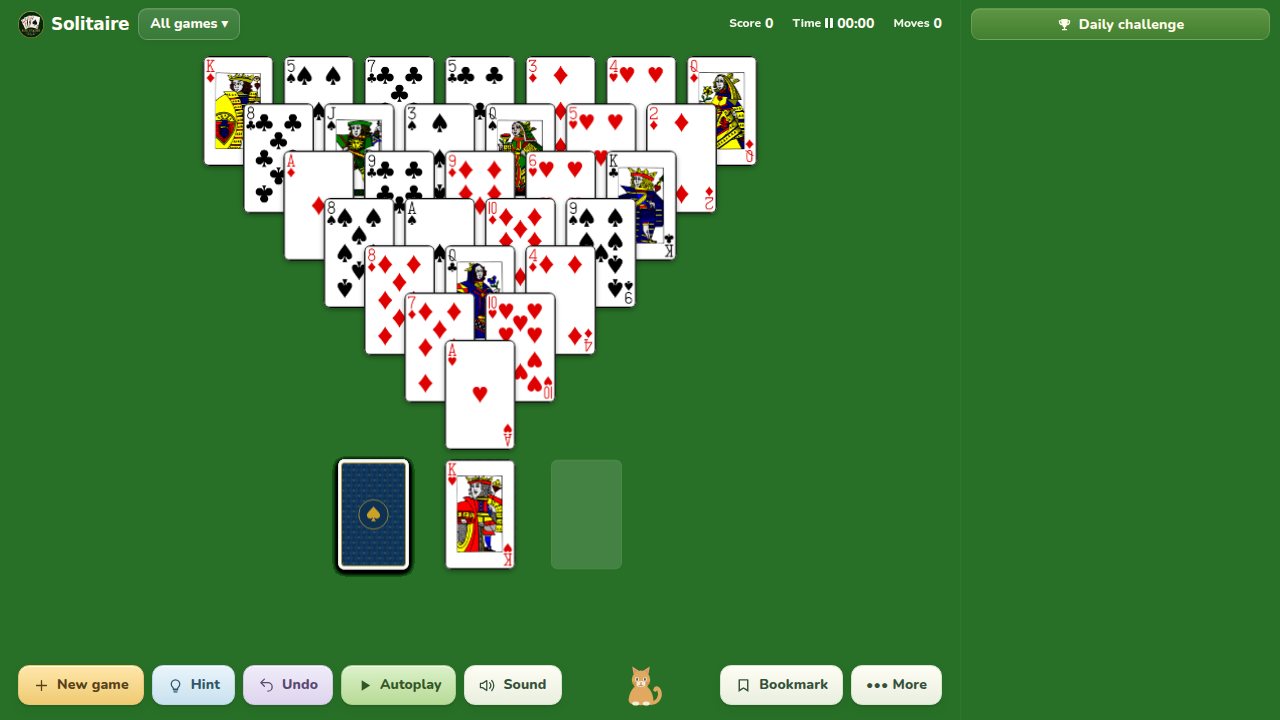
Pyramid turned upside down. Release its overlapping cards with pairs that total thirteen.
The inverted layout changes which removals expose cards above them. Check both the face-up stock card and the waste top as possible partners before tapping Next; the stock has only one pass.
Rules and objective
- An inverted pyramid holds 28 face-up cards: seven across the top, shrinking to one in the last row.
- Tap two uncovered cards totaling thirteen, or a King alone. Aces count as one, Jacks eleven and Queens twelve.
- The exposed stock card and top waste card are both available for pairing. Removing the exposed stock card reveals the next one.
- Tap Next to move the exposed card to the waste and reveal another. There is one stock pass and no redeals.
- Clear the inverted pyramid to win. Empty pyramid spaces cannot be filled.
The table enforces legal moves and saves the current deal in this browser. Hints identify a move that is available now; they do not guarantee that the deal can still be won.
Strategy: how to play better
First priority
Look for pairs involving the lowest overlapping cards to release more choices.
Work from the overlap
Removing a card near the narrow lower end can uncover several cards above it. Compare that gain before spending a stock card.
Distinguish stock and waste
The exposed stock card and waste top are both playable. Use the one that reveals the stronger next option; there is no redeal.
Frequently asked questions
Can I pair a pyramid card with the exposed stock card?
Yes. Both the exposed stock card and the top waste card are available for a thirteen-point pair.
Can I go through the stock again?
No. Tapping Next advances the stock once; there are no redeals.