Look for open sides
A tile is free when nothing covers it and its left or right side is open.
 Solitaire-Online
A tile is free when nothing covers it and its left or right side is open.
Choose two matching tiles. Clear the upper layers to open up more possibilities.
There’s no time limit. Use a hint, undo a move, or shuffle when you need a fresh look.
Complete illustrated guide
Learn which tiles are free, how special tiles match and how to avoid blocking the pairs you will need later.
Mahjong Solitaire is a one-player matching puzzle played on a layered arrangement of tiles. Remove matching open pairs until the board is empty. The challenge is not finding a match; it is choosing pairs that uncover useful tiles without trapping their partners.
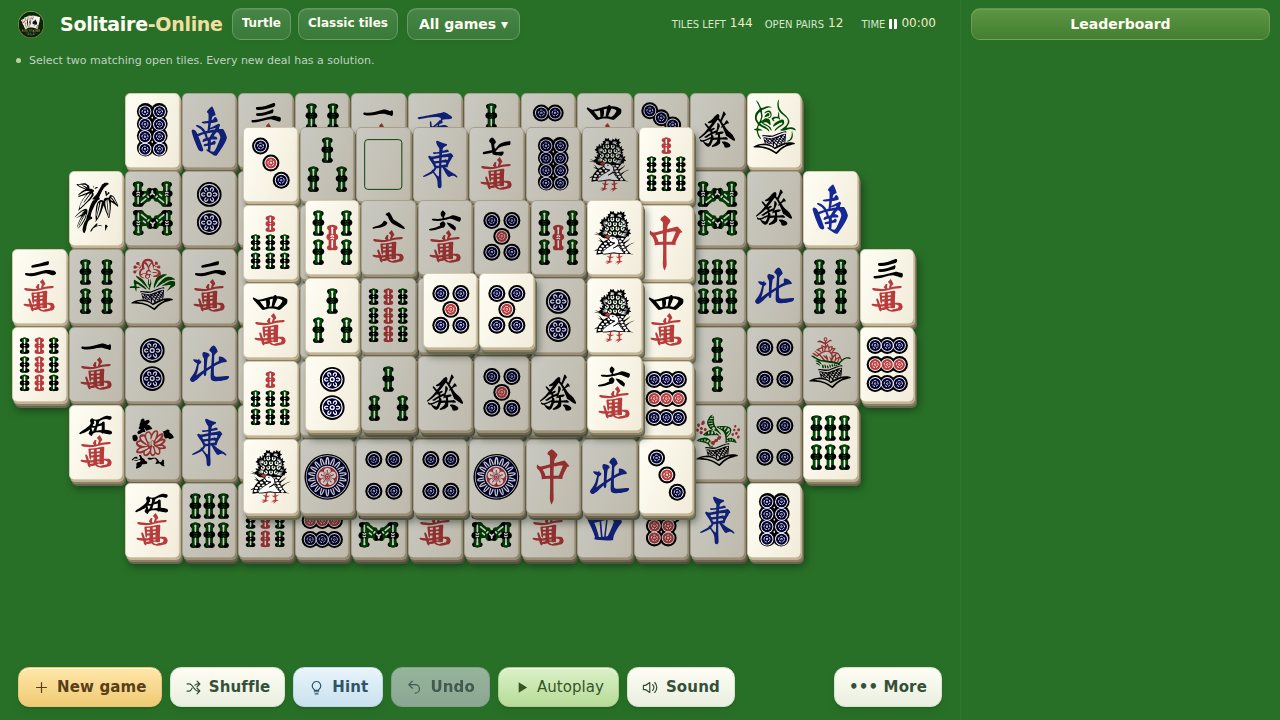
Choose Turtle for the traditional 144-tile layout, Courtyard for a shorter 72-tile game, or Pyramid for a 96-tile challenge. New deals begin solvable, although later choices can still block the board.
Pairs that remove high tiles or open the ends of long rows usually create more options than pairs already sitting free.
When three or four copies are open, choose the pair that uncovers the most useful positions. The obvious pair is not always the safest one.
A board can stall when one side remains locked. Balance your removals so that new tiles become available across the layout.
A hint shows a legal pair, not necessarily the best pair. Undo is ideal for testing alternatives; shuffle is the recovery option when no open pair remains.
No. Mahjong Solitaire borrows the tiles, but it is a single-player matching puzzle rather than a game of hands, melds and discards.
Every new deal and successful shuffle begins with at least one solution. Your choices can still create a blocked position, so use undo or shuffle if needed.
No. Any flower pairs with any other flower, and any season pairs with any other season.
Yes. The current board, artwork choice and sound preference save locally in this browser when storage is available.