 Solitaire
The Case for Draw 3
One setting changes Klondike from a game of luck with occasional decisions into a game of decisions with occasional luck.
What actually changes
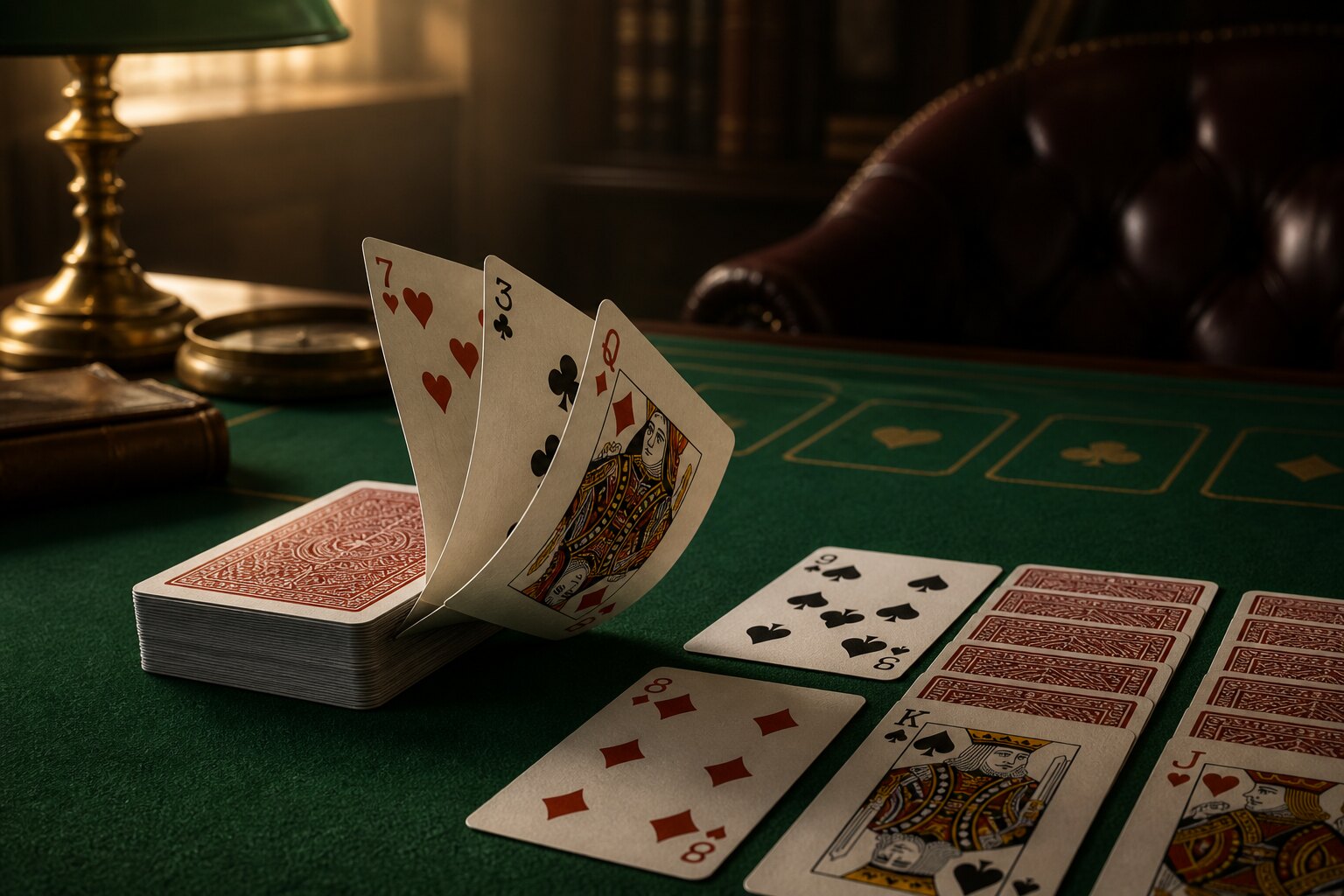
The mechanical difference is one sentence long. In Draw 1 you turn a single card from the stock and it is immediately available. In Draw 3 you turn three and only the topmost is in play; the two beneath it are visible but locked until the pile shifts.
The consequence is much larger than the rule. In Draw 1, the stock is not really a constraint — every card in it will come to you eventually, so the game is essentially about the tableau. In Draw 3, the stock becomes a rotating mechanism with a fixed period, and playing a card changes the alignment of everything behind it for every future pass.
The honest odds
Draw 3 wins much less often, and it is worth being clear about the scale of the difference so you do not read your own losses as incompetence.
| Mode | Typical win rate, good play | What limits you |
|---|---|---|
| Draw 1, unlimited passes | roughly 40–50% | The tableau. Buried cards and dead columns. |
| Draw 3, unlimited passes | roughly 10–15% | Stock alignment. The card you need is permanently in the middle of a triple. |
| Draw 3, three passes only | lower still | Time. Deals die with moves still on the table. |
These are ranges, not constants — they move with the redeal rule, the scoring variant and how much the player is willing to think. The shape is what matters: a mode where you lose most games is not a broken mode, it is a different game.
Learning to think in cycles
Twenty-four cards in the stock, three at a time, is eight triples per pass. Play one card from the waste and every subsequent triple re-partitions: cards that were buried become tops, and cards that were tops disappear into the middle.
This is the single skill Draw 3 teaches and Draw 1 cannot. When you take a card off the waste, you are not just making a move — you are shifting the phase of the entire stock. Sometimes the correct play is to take a card you do not need in order to change which cards become reachable next pass. Draw 1 has no equivalent decision anywhere.
Four rules that only apply in Draw 3
1. Make a full pass before committing. Cycle the stock once, without playing anything, to see what is there. You lose nothing and you learn where the aces and the key low cards are sitting.
2. Take the card you need, not the card you can. Playing a card off the waste purely because it is legal is the most common Draw 3 error. Every waste play costs you the alignment; make it buy something.
3. Prefer tableau moves to waste moves. If a card can come from either the tableau or the waste, take it from the tableau. That unburies a face-down card and leaves the stock phase untouched — two benefits for one move.
4. Count what is still in there. By the second pass you should know roughly which cards remain in the stock. When the deal stalls, the question is not "what can I do now" but "is the card that unlocks this still reachable at all".
So which should you play?
Play Draw 1 when you want a game — something to occupy the surface of your attention while the rest of your head is elsewhere. It is genuinely good at that, and there is nothing lesser about it.
Play Draw 3 when you want a puzzle. The wins are rarer and they feel entirely different, because in Draw 3 a win is much less likely to have been handed to you by the deal. You will lose most of them. That is the point: it is the only version of Klondike where playing better reliably shows up in the result.
Want the full rules? Read How to Play Klondike.
Frequently asked questions
What is the difference between Draw 1 and Draw 3 solitaire?
Draw 1 turns one card from the stock at a time, so every card in the stock is reachable. Draw 3 turns three at once and only the top of the three is playable, so roughly two thirds of the stock is inaccessible on any given pass.
Which version of Klondike is easier?
Draw 1 is substantially easier. Published estimates put good Draw 1 play in the region of 40–50% wins and Draw 3 closer to 10–15%, depending on the redeal rules and the standard of play.
Why does Draw 3 have unlimited redeals here?
Because the traditional three-pass limit ends a lot of deals on a technicality rather than on a mistake. Unlimited passes keep the difficulty in the decisions rather than in the clock.
Keep reading
Read the Deal in Ten Seconds
Most players start moving cards immediately. The stronger habit is to spend ten seconds reading the layout — because a Klondike deal announces its difficulty before you touch it.
Four-Suit Spider Is Winnable
Ten columns, two decks, four suits and a stock that punishes you for dealing too early. It is the hardest solitaire most people ever try — and it rewards a plan.
The FreeCell Deal Nobody Could Solve
Thirty-two thousand numbered deals. A volunteer army with dial-up modems. One layout that refused to fall — and it is still refusing.