 Solitaire
Read the Deal in Ten Seconds
A Klondike layout is not a random wall of cards. It is a set of signals about where the game will get stuck — and four of them are visible before your first move.
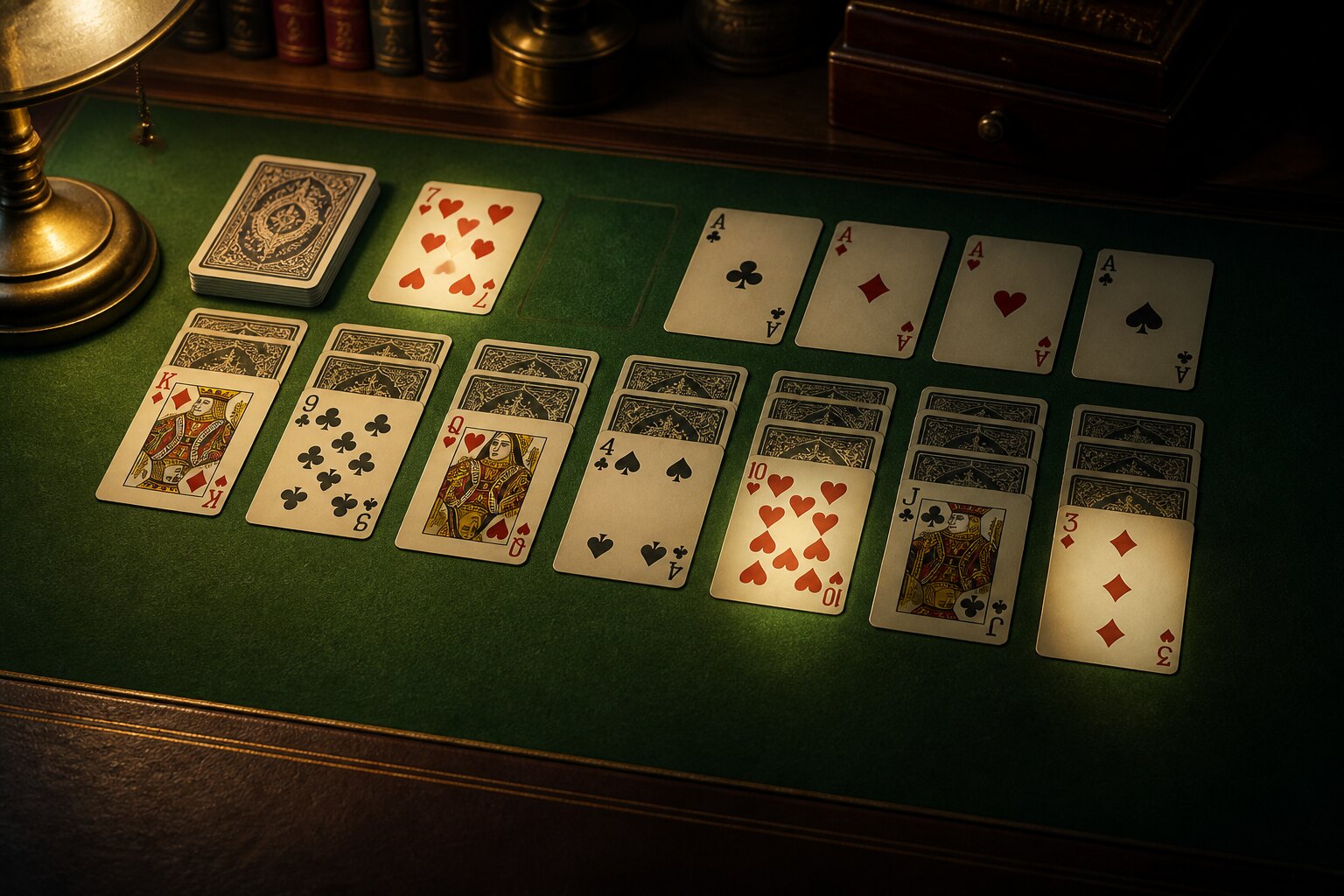
Why the first ten seconds matter
Klondike punishes moves that cannot be taken back, and the earliest moves are the ones most likely to be irreversible. Send a two to the foundation on move one and you may have removed the only card that could have accepted a specific ace-adjacent run later. Empty a column early and fill it with the wrong king and you have converted your most valuable asset into a wall.
The players who win more are not calculating deeper. They are reading the board once, deciding what kind of game this is, and then playing accordingly. That decision takes ten seconds and it is made from four signals.
Signal one: where the aces are
Aces are the only cards that are always safe to play and always necessary. Their position in the layout is therefore the single strongest predictor of how the game will open.
Count the aces you can see. Then note which column they are in, because that matters more than how many.
| What you see | What it means |
|---|---|
| Two or more aces face up | A fast start. You will get foundations moving before the stock is even involved. |
| One ace, in a short column (1–3) | Comfortable. Short columns unbury quickly, so the cards behind it are cheap to reach. |
| One ace, in column 6 or 7 | Deceptive. You have the ace, but the six cards behind it are the ones that decide the game. |
| No aces visible | A stock-dependent deal. Play conservatively and expect to make several passes before anything opens up. |
Signal two: the seventh column
The rightmost column holds seven cards — six face down. It is, by a wide margin, the most expensive real estate on the board. Every card you want from it costs six unburials, and each of those unburials needs a legal home somewhere else.
So look at what is sitting on top of it. A low card — anything from a two to a six — is excellent news: it has plenty of potential landing spots, so the column can start moving early. A queen or a jack on top of column seven is a warning. It needs a specific king or a specific opposite-colour high card to shift, and until it shifts, a fifth of the deck is inaccessible.
Signal three: kings on top
Kings are immovable except into an empty column. A king face-up at the base of a column is not a problem — it is where a king belongs. A king face-up at the top of a column, sitting on other cards, is structural damage: nothing can ever be placed on it, and it cannot leave until you have created an empty column to receive it.
One such king is normal. Two is a genuinely hard deal. Three, and you are playing a puzzle where the whole game turns on manufacturing an empty column before the stock runs dry.
Signal four: the colour balance
This one takes two seconds and almost nobody does it. Glance at the seven face-up cards and count red against black.
Klondike builds in alternating colours, so a layout of six reds and one black has almost no internal moves available — nearly every card needs a partner that is not on the table. A four-three or three-four split is healthy: cards can start talking to each other immediately, which means you unbury face-down cards without spending stock passes.
Putting it together
The scan produces one of three verdicts, and each one changes how you play the opening rather than whether you play at all.
Open deal. Aces visible, low cards on the deep columns, balanced colours. Play quickly and greedily; the risk here is overthinking a game that wants to be won.
Working deal. One ace, mixed signals, a high card or two in the wrong place. This is where discipline pays: do not send anything above a three to the foundations early, and prioritise the deep columns over the shallow ones even when the shallow move is prettier.
Hard deal. No aces, kings stranded on top of columns, a lopsided colour count. Your entire plan is to create one empty column. Every move should be judged against that single goal, and if the stock gives you nothing in two passes, this deal probably had nothing to give.
None of this is certainty. Twenty-one cards are face down and no amount of reading changes that. But it converts the opening from a series of reflexes into a plan, and over a hundred games the difference is not subtle.
Want the full rules? Read 12 Klondike Strategy Tips.
Frequently asked questions
Can you tell if a Klondike deal is unwinnable just by looking?
Not with certainty — most of the deck is face down, so no visual scan can prove a deal is dead. What the scan gives you is a good estimate of difficulty, which changes how carefully you should play rather than whether you should bother.
Should I restart a bad-looking deal?
If you are playing for a win rate, yes — a deal with three kings showing and no accessible aces is a poor use of the next ten minutes. If you are playing for the pleasure of a hard problem, the ugly deals are the interesting ones.
Keep reading
The Case for Draw 3
Draw 1 is the mode most people play and the one that teaches you least. Draw 3 turns the stock from a slot machine into a resource you have to manage.
Four-Suit Spider Is Winnable
Ten columns, two decks, four suits and a stock that punishes you for dealing too early. It is the hardest solitaire most people ever try — and it rewards a plan.
How Solitaire Conquered the Office
It was never meant to be a game. It was a mouse tutorial with a green baize disguise — and it ended up on more desks than any piece of software ever written.