 Solitaire
Four-Suit Spider Is Winnable
Most players bounce off four-suit Spider because they play it like one-suit Spider with extra steps. It is a different game, and it has its own rules of thumb.
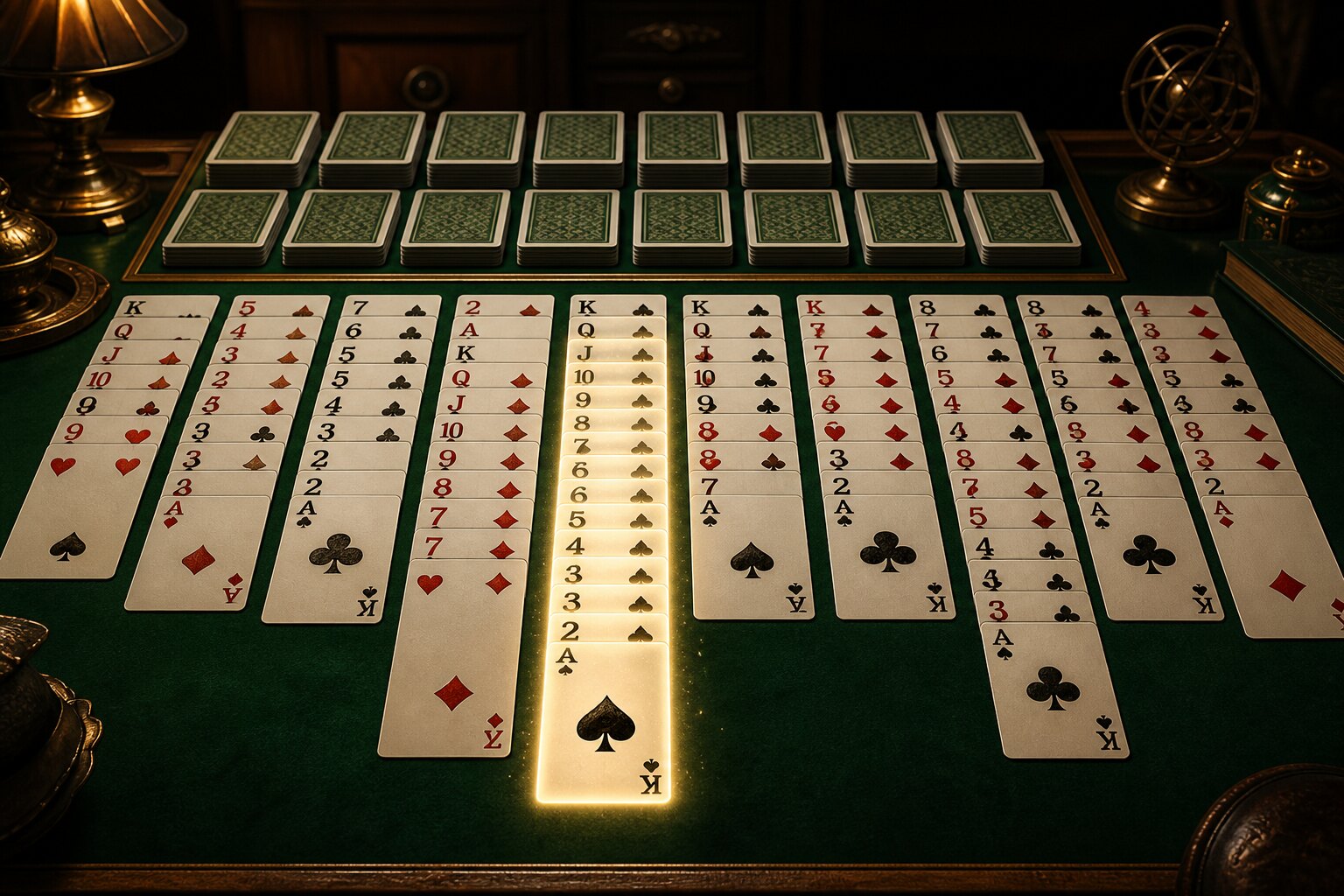
What changes with four suits
In one-suit Spider, any descending run is a real run — it can always be moved as a unit, so the board stays fluid and the game is mostly about not wasting space. Add suits and that stops being true. You can still place a card on any card one rank higher, regardless of suit, but you can only move a group if it is in sequence and all one suit.
That single distinction creates the defining object of four-suit Spider: the mixed pile. A run of eight descending cards in five different suits looks tidy and is functionally concrete. Nothing in it can move except the bottom card, and everything under it is entombed.
The empty column is the whole game
An empty column in Spider does three jobs at once, and no other resource in the game does any of them.
It is a workshop: you can dismantle a mixed pile one card at a time by parking cards there. It is a king's home: without one, kings never move again. And it is the only way to reorganise, since Spider has no free cells, no foundations you can park on, and no waste pile.
The catch is the deal rule. You cannot deal a new row from the stock while any column is empty. So an empty column is not just valuable — it is valuable and perishable, because at some point you will need to deal, and dealing requires filling it back in.
This produces the central tension of the game. Every empty column is a question: do I spend it now on the knot in front of me, or hold it and accept that dealing will consume it anyway?
| Situation | Spend the empty column |
|---|---|
| You can free a complete same-suit run of 5+ cards | Yes, immediately |
| You can unbury a face-down card in a deep column | Usually yes |
| You can relocate a king out of the middle of a pile | Yes — kings only get harder later |
| You want to make one tidy-looking mixed run | No. This is how empties are wasted |
| The stock is nearly out | Hold it. Late empties are worth far more |
Build in suit, even when it hurts
The most common four-suit mistake is taking the available move rather than the useful one. A red nine will go on any ten. Putting it on the spade ten because that ten is convenient costs you nothing today and everything in ten moves, when the nine and the spade run underneath it have become one immovable block.
The rule of thumb that fixes most players' four-suit game: if a card can go in suit, put it in suit; if it cannot, ask whether it needs to move at all.
Off-suit placements are not forbidden — sometimes you must, to unbury something or to survive a deal. But they should be deliberate, and you should know as you make one roughly how you intend to take it apart.



When to deal, and when not to
Dealing is the only irreversible thing in Spider. Ten new cards land on top of your columns, on top of whatever careful arrangement you had, and you cannot take them back.
So the discipline is simple to state and hard to follow: exhaust every useful move before you deal. Not every legal move — every useful one. Specifically, before touching the stock, check that you have:
Completed and removed any full king-to-ace suit run available. Unburied every face-down card you can reach. Consolidated same-suit runs that are currently split across two columns. And made sure no column is so short that the deal will bury something critical.
That last one matters more than people expect. A column holding a single exposed six is about to become a column holding a six with a random card on it. If that six is the top of a run you need, move it first.
A move-order checklist
Run this order on every turn and most of four-suit Spider's decisions make themselves.
1. Can I complete a full suit run, king down to ace?
Do it. Thirteen cards leave the board permanently.
2. Can I unbury a face-down card without breaking an
in-suit run? Do it.
3. Can I join two parts of the same suit? Do it.
4. Can I empty a column? Consider it seriously against
the table above.
5. Is there an off-suit move I actually need? Make it
knowingly, not reflexively.
6. Only now: deal.
What to expect
You will lose most four-suit games, and that is the correct outcome rather than evidence of doing it wrong. The variant is hard in a way that no amount of skill fully overcomes: two decks, fifty face-down cards, and a stock that forces its way onto the board on its own schedule.
What improves with the approach above is not the win rate alone but the shape of the losses. Badly played four-suit games die early, in a mess of mixed piles, with the stock half full. Well played ones die late, with three suits removed and one card in the wrong place — and those are the games worth playing it for.
Want the full rules? Read How to Play Spider.
Frequently asked questions
What is a good win rate at 4-suit Spider?
Low. Casual players win a few percent of four-suit games; careful play with undo can push that considerably higher, but it remains far below one-suit Spider, where a strong player wins the large majority of deals.
Can you deal when a column is empty in Spider?
No. The standard rule, which we follow, is that every column must contain at least one card before you can deal a new row from the stock. This is the constraint that shapes the entire game.
Should I play 1-suit Spider first?
Play one suit to learn the shape of the game and two suits to learn the cost of mixed builds. Four suits assumes you already know both.
Keep reading

The Case for Draw 3
Draw 1 is the mode most people play and the one that teaches you least. Draw 3 turns the stock from a slot machine into a resource you have to manage.

Read the Deal in Ten Seconds
Most players start moving cards immediately. The stronger habit is to spend ten seconds reading the layout — because a Klondike deal announces its difficulty before you touch it.

The FreeCell Deal Nobody Could Solve
Thirty-two thousand numbered deals. A volunteer army with dial-up modems. One layout that refused to fall — and it is still refusing.