 Solitaire
Napoleon Did Not Invent Solitaire
Patience games were being written down in northern Europe while Napoleon was still a lieutenant. So why does every account begin with St Helena?
The story everyone tells
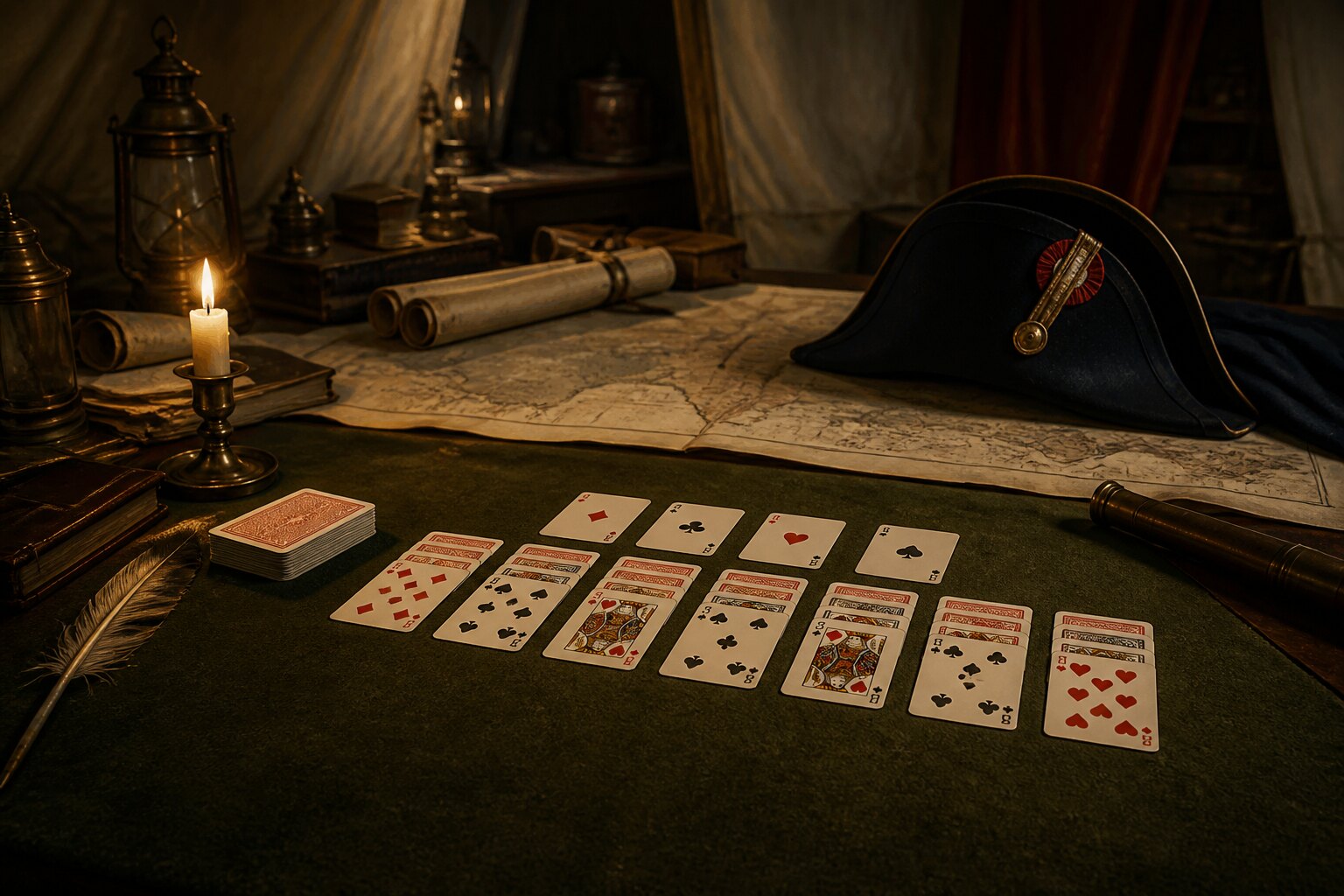
You have read this version. Napoleon Bonaparte, exiled to St Helena in 1815, with nothing to fill the days, invents a game of cards to play against himself. The image is irresistible: the most restless man in Europe, reduced to dealing solitaire on a rock in the South Atlantic. It appears in game books, on packaging, and in roughly half the articles written about the history of solitaire.
It is almost certainly not true, and the evidence against it is not subtle.
What the record actually shows
Games of patience are documented in northern Europe well before Napoleon's exile. German and Scandinavian game anthologies of the 1780s describe patience-style games — a period when Napoleon was a teenage artillery officer with no particular connection to card games or to anything else the wider world was paying attention to.
The vocabulary tells the same story. The word patience for solo card play enters English and French from German usage, not the other way round. And when the games arrive in Britain in the nineteenth century, they arrive as an established genre with existing conventions, not as a novelty someone had recently made up.
How his name got attached
Here is the part that makes the myth make sense. Several patience games genuinely are named after Napoleon — most familiarly Forty Thieves, widely known as Napoleon at St Helena, along with variants carrying names like Napoleon's Square and St Helena.
Nineteenth-century card games were named after famous people the way Victorian roses were: as decoration, not attribution. But a game called Napoleon at St Helena is one small step away from a story about Napoleon at St Helena, and over a century that step gets taken, repeated, printed, and eventually cited.
| Date | What actually happened |
|---|---|
| 1780s | Patience games described in German and Scandinavian game anthologies. |
| 1815–1821 | Napoleon's exile on St Helena. Contemporary accounts of his daily life are extensive; card-game invention is not among the well-attested activities. |
| c. 1870 | Lady Adelaide Cadogan publishes an illustrated collection of patience games in England — the first widely read English-language book on the subject. |
| Late 1800s | A publishing boom. Dozens of collections, hundreds of named variants, several of them named after Napoleon. |
| 1990 | Klondike ships with Windows 3.0 and eclipses the entire preceding history in about five years. |
The Victorian boom
The period that really shaped solitaire as we know it is not the Napoleonic era but the late Victorian one. Cheap printing, mass-produced cards and a middle class with evenings to fill produced an explosion of patience literature. Lady Adelaide Cadogan's collection, published around 1870, was followed by a steady stream of rival volumes, each adding variants and each quietly renaming the games in the last one.
This is why solitaire nomenclature is such a mess. Klondike is also Canfield in Britain; Canfield is also Demon; Forty Thieves is also Napoleon at St Helena and Big Forty and Roosevelt at San Juan. There was never a governing body, only competing books.
Why the myth survives
Because it answers a question the true history does not. "Where did solitaire come from?" is unsatisfying if the answer is "gradually, in several places, from card games whose rules were adapted by people whose names we do not have." Napoleon on a rock is a story with a protagonist.
The real origin is more interesting once you accept it has no hero. Patience is one of the very few genuinely popular games that was never designed — it accumulated, over two centuries, out of thousands of small variations kept by people playing alone. Nobody invented solitaire for the same reason nobody invented folk songs.
Want the full rules? Read A Short History of Solitaire.
Frequently asked questions
Did Napoleon invent solitaire?
There is no good evidence that he did. Patience games appear in print in German and Scandinavian sources in the late eighteenth century, before Napoleon rose to prominence and decades before his exile on St Helena in 1815.
Why is a solitaire game called Napoleon at St Helena?
Forty Thieves is commonly known as Napoleon at St Helena, one of several patience games named after him in the nineteenth century. The names came first and the origin story was reverse-engineered from them.
Where did solitaire actually come from?
The earliest documented patience games are northern European, appearing in German and Scandinavian game anthologies from the 1780s. The games reached England and France in the nineteenth century, where the first dedicated books were published.
Keep reading

How Solitaire Conquered the Office
It was never meant to be a game. It was a mouse tutorial with a green baize disguise — and it ended up on more desks than any piece of software ever written.
Why We Still Play Alone
No opponent, no lobby, no season pass. Every trend in games for thirty years has pointed away from solitaire, and it has not moved an inch.
Read the Deal in Ten Seconds
Most players start moving cards immediately. The stronger habit is to spend ten seconds reading the layout — because a Klondike deal announces its difficulty before you touch it.