
Crazy Eights at a glance
Crazy Eights is the fast shedding game where every card must match the one before it, by suit or by rank. Eights are wild and let you change the suit. Empty your hand first and you score the cards your opponents are still holding.
- Players
- 2–6 · Every player for themselves
- Deck
- 52 cards
- Hand
- 7 cards (2 players) or 5
- Target
- 100 points
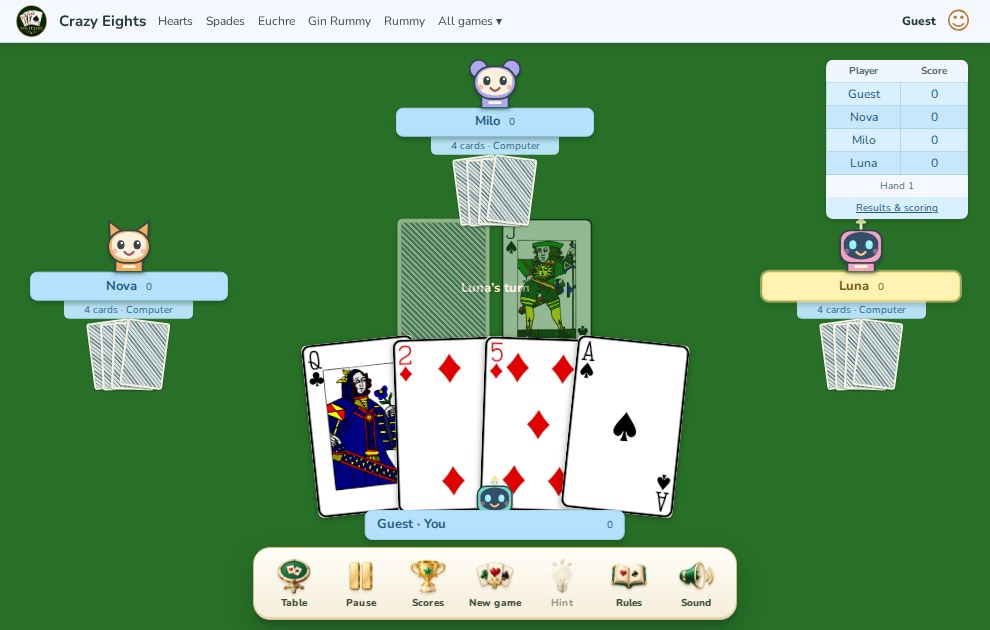
How to play Crazy Eights online
Play free in your browser, with no download or account required. Choose the kind of table you want to join.
Practice with computers
Choose Play with computers and a pace: Relaxed, Friendly, or Quick. Use Hint when you need help finding a move.
Invite your friends
Choose Invite friends and share Copy invite or the room code. Friends join through Have an invite? The host can fill empty seats with computers.
Find an online opponent
Choose Find online players to look for other people. If no matching players are available, you can practice with computers instead.
Computer games also need an internet connection. The table handles dealing, legal moves, and scoring. These rules describe the version played here; other tables may use different house rules.
Rules of Crazy Eights
Deal and the first card
With two players each receives seven cards; with three to six, five. The next card starts the discard pile; an eight is buried in the stock and another card turned instead. The player left of the dealer starts.
Matching and wild eights
On your turn, play one card that matches the top card’s suit or rank. Eights are wild: play one at any time and name the suit the next player must follow.
Drawing and passing
If you have no card you can play, draw from the stock one card at a time until you can. When the stock is empty and you cannot play, you pass.
Scoring and winning
Going out and scoring
The first player to empty their hand wins the hand and scores the cards left in the other hands: eights 50, kings, queens and jacks 10, aces 1, other cards face value.
Blocked hands and winning
If the stock is empty and nobody can play, the player with the lowest hand scores the difference from each other hand. The first player to reach 100 points wins the game.
How to get better at Crazy Eights
Save your eights
An eight can be played on anything, so it is your escape when nothing else matches. Use matching cards first and keep the eight for when you are stuck.
Name the suit you hold
When you play an eight, name the suit you have the most of. You are more likely to play again next turn.
Shed high cards early
Face cards cost your opponents 10 points if you go out, and they cost you 10 if someone else does. Play them while they still match.
Watch hand sizes
When an opponent is down to one or two cards, change the suit away from what they have just been playing.
Frequently asked questions
Can I play an eight on anything?
Yes. An eight can be played whatever the top card is. You then name the suit the next player must follow, and they can also play another eight.
Do I have to draw if I can play?
No. You draw only when you have no card that matches, one card at a time, until you can play. When the stock is empty and you still cannot play, you pass.
How is Crazy Eights scored?
The player who goes out scores the cards left in everyone else’s hand: eights 50, face cards 10, aces 1 and other cards their face value. The first to 100 wins.
What if nobody can play?
If the stock is empty and every player passes, the hand is blocked. The player with the lowest hand scores the difference from each other hand.
Can I play Crazy Eights against computers?
Yes. Choose Play with computers at the table and select a computer pace. Private tables can also mix friends with computers. An internet connection is required.
How do I invite friends to Crazy Eights?
Choose Invite friends, then use Copy invite in the waiting room. Friends can open that link or enter the room code in Have an invite? The host can fill empty seats with computers.
 Rummy
 Go Fish
 Gin Rummy